James W. Fowler, born in 1832, was a son of William Fowler and Rhoda Moseley. He married his cousin Caroline Hodge (1830-1912) a decade before the war began, and a child was born every two years until he heeded the call to battle.
- Desdamona Fowler (1854–1887)
- William Edward Fowler (1856–1894)
- James Monroe Fowler (1858–1931)
- Kansaby Fowler (b. 1860)
Once the Civil War commenced, James W. Fowler said farewell to his family and traveled to Unionville to enlist in Company B, 18th Regiment South Carolina Infantry. It was December 17, 1861, and he was thirty-one years old.
His initiation into the army was at Camp Hampton near Columbia, SC.
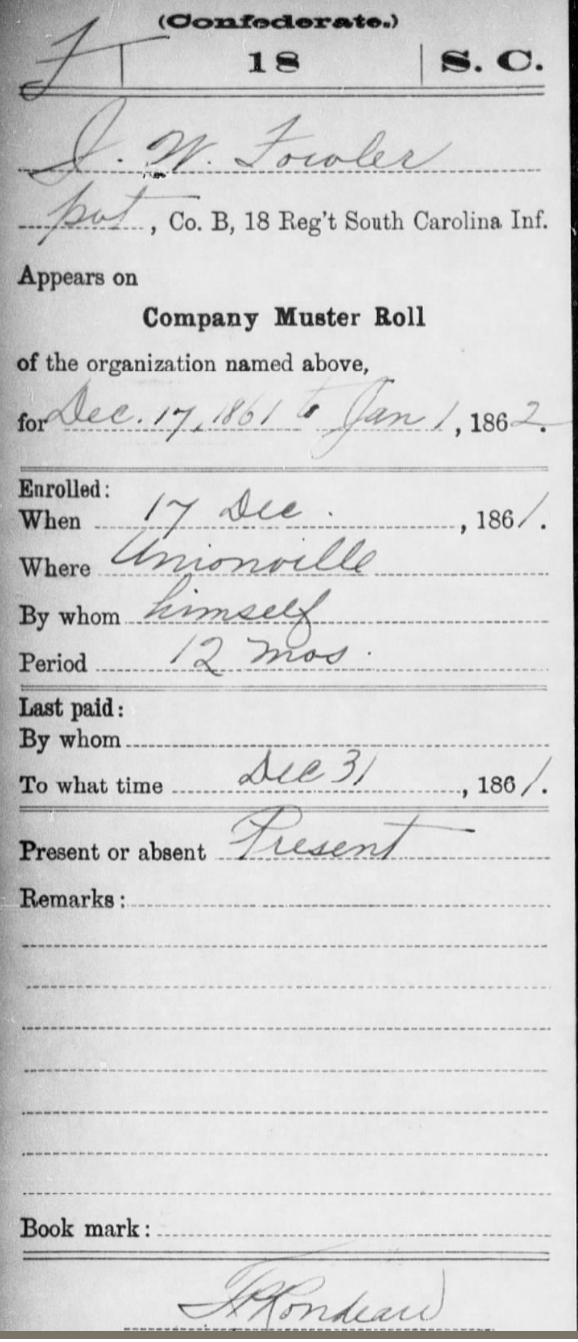
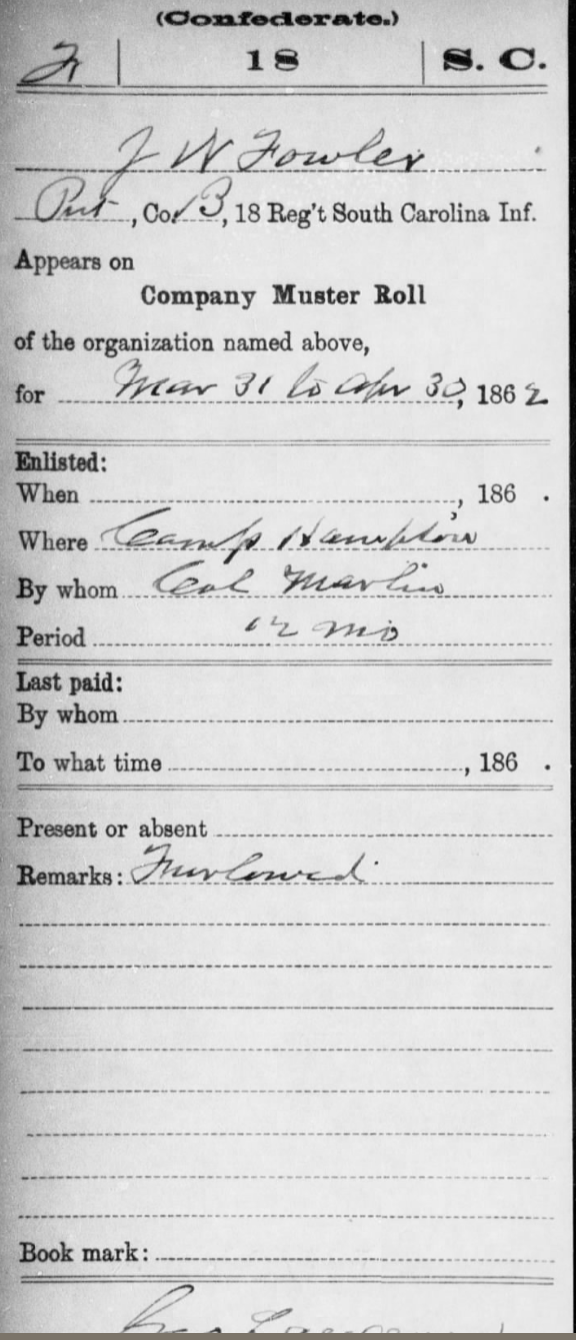

James W. Fowler had enlisted for twelve months. He would live for nine.
The Company Roll call from March 31 to April 30, 1862 listed James W. Fowler as furloughed. If he went home during this time away from the battlefield, it would be the last time he would see his wife and children.
Union County lost some of her finest men in the battle of First Manassas/Bull Run on July 21, 1861. More would fall in Second Manassas/Bull Run which took place on the same hallowed ground August 28-30, 1862.
No matter that both the First and Second Manassas battles were significant victories for the Confederate boys in gray, the Southern forces suffered great losses.
Between the 28th and 30th of August in the year of 1862, at Second Manassas, about 1500 Confederate soldiers were killed, and over 7500 were wounded.
James. W. Fowler was one of the wounded. He was felled by a gunshot injury to his leg. “Vulnus sclopetarium, fractured knee” were the words on his casualty report describing his fate.
For three long, agonizing days after the battle, three thousand of the wounded were still lying on the battlefield; most were Yankee soldiers unable to be moved as the battlefield was under Confederate control.
With no food or water or medical attention, or shelter from the elements, scores of soldiers died where they fell, no chance of survival.
How long did James W. Fowler lie on the battlefield before he was found and taken to a field hospital?
In 2014, human bone fragments were discovered near the battlefields of Manassas, later identified as two skeletons and seven amputated limbs of Union soldiers wounded at the 1862 battle. The bones were found in what was determined to be a surgeon’s pit dug between September 1 to 6, 1862 near a field hospital.
The Confederate doctors working in the makeshift field hospitals were overwhelmed by the sheer number of injured soldiers. The wounded who could withstand the trip were transferred to the CSA General Hospital in Warrenton, Virginia.
Was James W. Fowler’s leg amputated in a Confederate field hospital before he was transported to Warrenton? It is difficult to imagine the horrific pain that he must have suffered on the twenty-one mile journey — feeling every jolt, every excruciating step along the way.
If there is a merciful God above, perhaps James W. Fowler lost consciousness along the way.
Did his family back in Union County know that their beloved husband and father lay in a hospital in Virginia, unable to go to him to comfort and whisper their last words to him? When did they get the heartbreaking news?
James W. Fowler never made it home. He died on September 23, 1862 in that Virginia hospital. He lies in the Warrenton Cemetery along with 985 other Confederate soldiers.
Their graves were marked with wooden crosses until the Union Army inflicted one last indignity upon their enemy. The Yankee soldiers burned the wooden markers for firewood in the cold 1863 winter, and the locations of the buried Southern Soldiers were lost to us forever.
A monument was erected with the following inscription:
Confederate Dead
Six Hundred.
Virginia’s Daughters To Virginia’s
Defenders.
God Will Judge The Right.
Go Tell The Southrons We Lie Here
For The Rights Of Their States.
They Never Fail Who Die In A Great Cause.

Caroline Hodge Fowler did not get to say good-bye to her husband. She did not get the closure many feel as a coffin is lowered into the red clay ground of Carolina. Instead, she had the task of finding an attorney to cut a path through the governmental red tape to collect the final monies due her as a war widow. From the documents that I discovered, it was a monumental task.


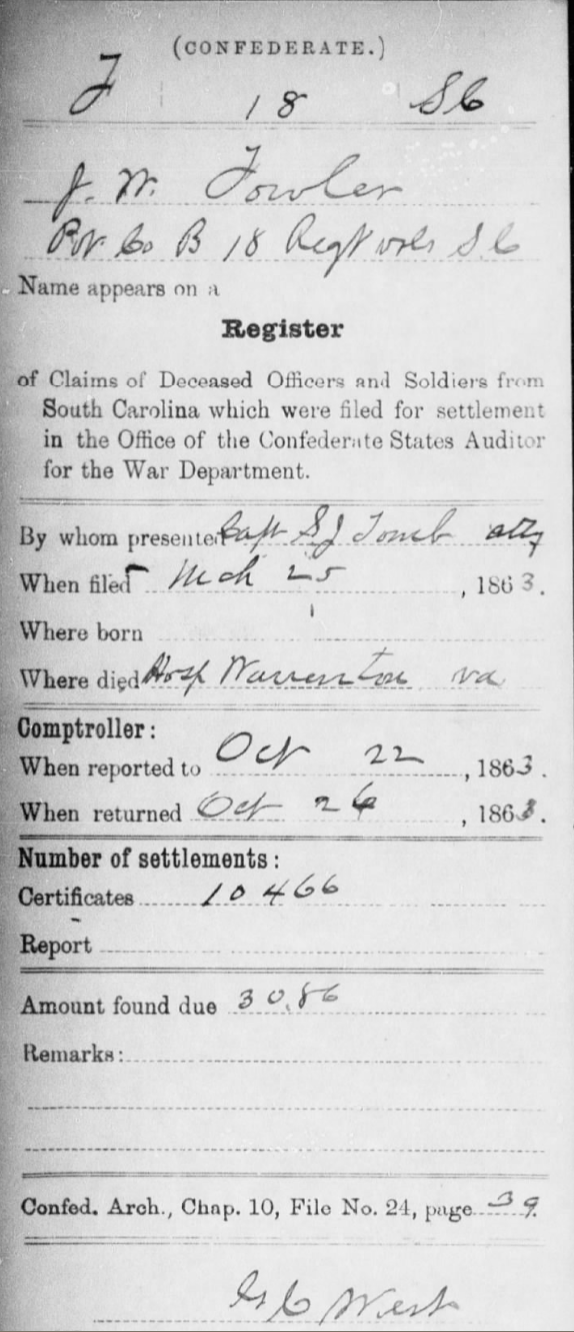
Confederate soldiers were paid $11 per month for their service in the army. If a soldier died within a pay period, the amount due to him was prorated from the last time he was paid until the day of his death.
The government administrators of the account of the deceased James W. Fowler determined that his death was on September 16, 1862 rather than September 23, 1862. The pay for the days he was lay wounded in a hospital receiving inadequate medical care before dying from infection was $5.86. He was also due $25 for clothing.
The total was $30.86 and it took one year and one month to decide that Caroline Hodge Fowler would get this amount. She lost her husband, the provider of her family, and she waited over thirteen months to get this small pittance to feed her children.
Caroline Hodge Fowler survived the war and its aftermath. She received food from the Freedman’s Bureau at least four times. She raised her children and one of her sons took her in when she became an old woman. The widow Fowler died in 1912. I sometimes wonder what she thought about the war that took her James William Fowler away from her……..
 THE FOWLER FAMILIES OF UNION COUNTY, SC