Close your eyes, for just a moment, and imagine that you have gone back in time.
It is 1850, and you are sick. Very sick.
You live in the American South where climate and living conditions contribute to the prevalence of infectious diseases. Poor sanitation and not understanding how diseases are transmitted allow illness to spread among the population.
You may have malaria, or yellow fever, or typhoid fever. You might have cholera, or dysentery; influenza or pneumonia; diphtheria, or scarlet fever; or the deadly tuberculosis.
Medical knowledge is limited in 1850, especially in the American South. Doctors are scarce in rural areas, but you are lucky enough to live close to a doctor. Someone in your family saddles the old mare and rides down dusty roads to get help.
The doctor who arrives has had very little medical training. He studied short-term with a preceptor and attended lectures at the Medical College of South Carolina in Charleston.
He had no extensive clinical experience before he was given the title of “Doctor.” You hope he knows a little more than the locals who use home remedies and folk beliefs to heal.
Common medical practice during the 1800s included bloodletting, blistering, and the use of mineral poisons. All of these treatments often increased suffering and hastened death.
The doctor who is standing at your bedside is Doctor Wade Fowler. The subject of his thesis — while at the Medical College of South Carolina in 1849 — was Blood Letting.
No matter your illness, you are probably going to have leeches placed on your body to remove the “bad” blood believed to be a source of your disease.
Maybe you will recover. Maybe you will die.
WHO WAS WADE FOWLER?
Wade Fowler was born February 27, 1820 in Union County, South Carolina. He was the first born son of James Fowler (1793-1858) and Susan Gault (1800-bef 1850).
HIs father James was the first born son of Godfrey Fowler (1773–1850), son of Henry Ellis Fowler (1746-1808).
In 1820, James Fowler, wife Susan, and infant son Wade lived in the household next to Godfrey Fowler and family.

I find no census record for James Fowler in 1830 or 1840. He reappeared in 1850, a widower with a few of his younger children.
A SCHOOL IN 1840
In the 1840 Union County SC Census, twenty-year-old Wade Fowler was Head of Household. No wife, no children….. he was alone.
But there was a mention under schools. I have never seen this before or since:
- 1 Primary and Common School
- 25 Scholars
- 5 Scholars at Public Charge
My interpretation of this data on the 1840 census is that Wade Fowler had a school with 25 students. I do not know if I am correct in my assumption. Please comment if you have any thoughts on this matter.


MEDICAL SCHOOL IN CHARLESTON
At the Medical College of South Carolina, the 1849 Thesis of Wade Fowler was on the subject of Blood Letting.

The Medical Society of South Carolina was incorporated in 1794. The S.C Legislature , in 1823, authorized the Medical Society to organize a medical school in Charleston at their own expense. Thus began the Medical College of South Carolina. Seven Charleston physicians formed the initial faculty with 30 students enrolled in 1824. The first graduation was on April 4, 1825. With the exception of the American Civil War, the college has served continuously to the present, even when there was a total enrollment of two students.
MARRIAGE
Wade Fowler was Doctor Wade Fowler and married to Elizabeth Ann Carothers by November 23, 1850, the day census taker D.W Johnson paid a visit to the Fowler home.

Dr. Wade Fowler married well. Elizabeth was the daughter of John Carothers (1775–1854) and his second wife, Rachel Ross Burrows (1805–1890).
AN INFLUENTIAL FATHER-IN-LAW
John Carothers had been a member of the South Carolina Legislature (1828-1829) and was a ruling elder in the Presbyterian Church. He had a good reputation among his friends and neighbors, a man who could be counted on, a good Christian man.
There was controversy over the interpretation of the Last Will and Testament of John Carothers after his 1854 death. One of his children had been left out of the will, and there was disagreement between his young widow Rachel and her children, and the children of his first wife, Mary Hope (1782–1826). I will leave this for another day, another article!
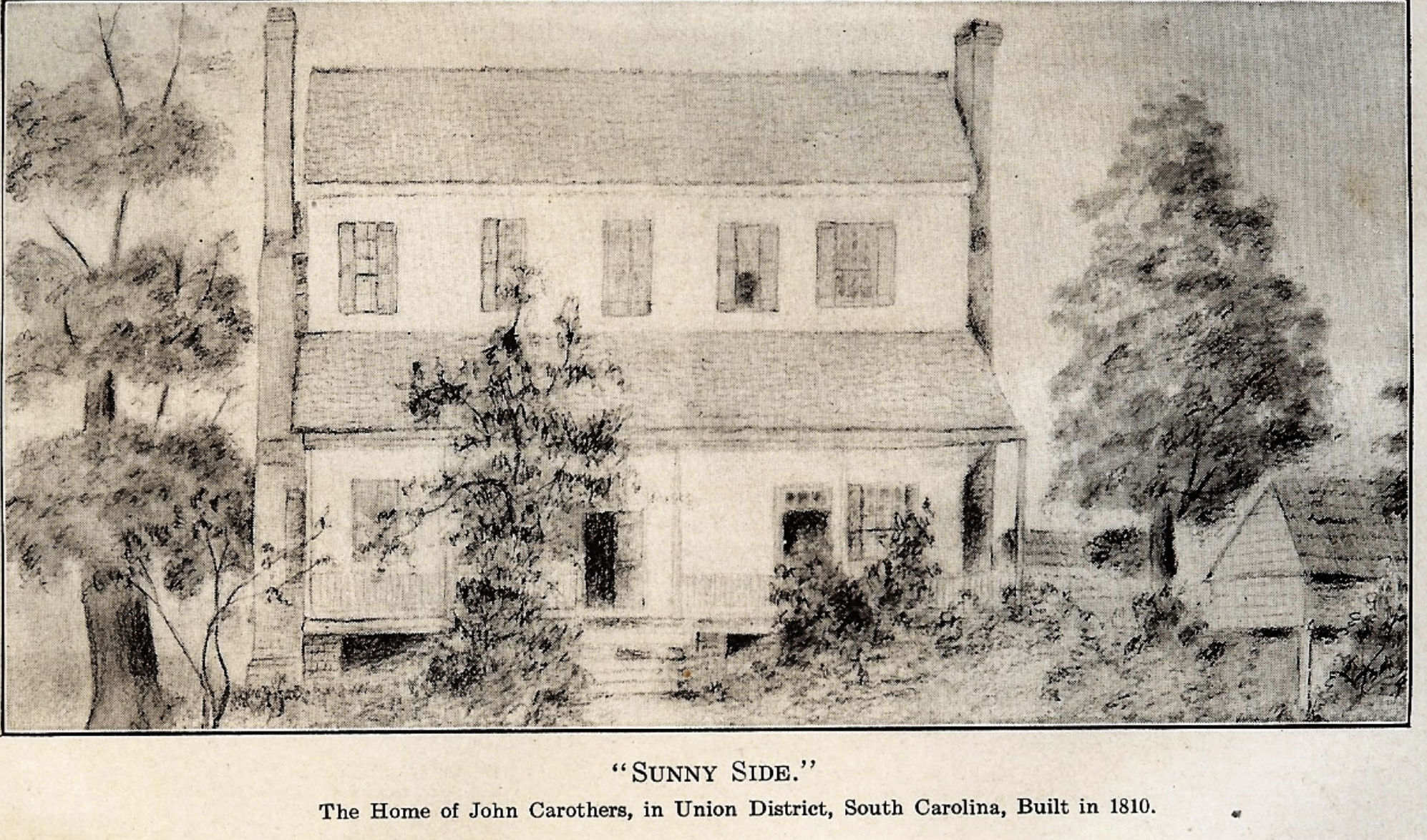
SUNNY SIDE
After the 1854 death of John Carothers, Wade Fowler, wife Elizabeth and their eight-year-old son John moved into the home called Sunny Side with Elizabeth’s mother, Rachel Ross Burrows Carothers. The house was built in 1810, north of the Pacolet River in Union County, but now in Cherokee County.

THE WAR
I find no records that Dr. Wade Fowler served in the Civil War. He was forty-one years old when the war began, perhaps too old to go into battle, perhaps he was needed more at home.
The war years are somewhat of a blank for the doctor. The only document that I have found is for tax owed on a watch valued at $100.
U.S., IRS Tax Assessment Lists, 1862-1918 for Wade Fowler
District 3; Annual, Monthly and Special Lists; 1864-1866

His youngest brother, Samuel Waddy Fowler (b. 1843) did enlist in the Confederate Army and died, aged 18, on December 16, 1861 at Adams Run, Charleston County, South Carolina.
AFTER THE WAR
It is fairly obvious to see that Dr. Wade Fowler was a respected member of the community. He was not only a healer, but also an active participant in many organizations.
The doctor was involved with the Skull Shoals Mason Lodge. He gave a fine speech outlining the attributes and principles of the Masons at a picnic in June 1869 in front of about three hundred people.

Yorkville Enquirer
York, South Carolina
Thu, Jul 1, 1869 · Page 2
The year 1870 brought some changes to the Dr. Wade Fowler home. He and Elizabeth were still living with Rachel Burrows Carothers in Gowdeysville north of the Pacolet River.
A daughter, Sarah Ross Fowler, was born. She was nine-years old in this census record.

Son John Clark Fowler no longer lived in the household with his parents. I found John Fowler working as a Clerk and living with merchant Alfred Foster in Unionville.
I do not know if this eighteen-year old John Fowler was the son of Wade Fowler, but it seems logical to me that an educated doctor would send his son off to school, or somewhere to learn a trade.

DR. WADE FOWLER AND THE ENSLAVED
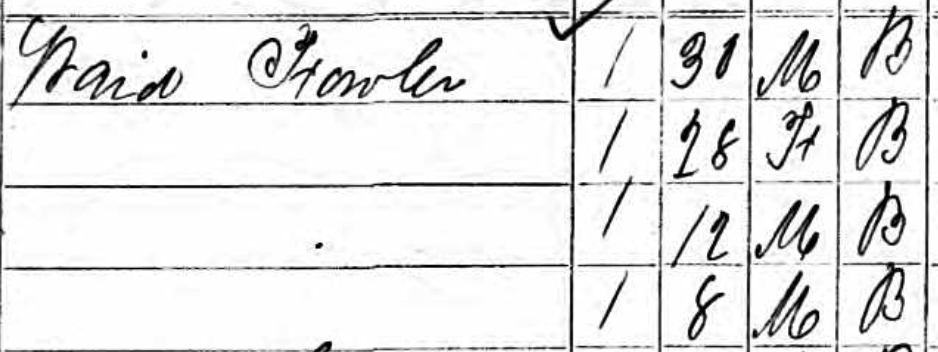
Dr. Wade Fowler had enslaved people in his household. The Slave schedules confirm one adult female and one male child in 1850; and one adult male, one adult female, and two male children in 1860.

Please click on the link below and read a very detailed article I wrote about the enslaved men, women and children and Dr. Wade Fowler:
THE KKK, AND THE ARREST OF THE DOCTOR
Many white men in the south joined the dreaded Klu Klux Klan after the war. Dr. Wade Fowler was no exception. Union County, South Carolina was a hotbed of Klan activity and many horrible acts of violence and murder took place there.
Trial transcripts of suspected Klan members will give you an idea of how bad it was to be a person of color once the KKK was organized. White sympathizers also were tortured and murdered for their compassion for their black brethren. It was a terrible time to live — or die- through.
I found a few mentions in old newspapers of Dr. Wade Fowler’s involvement with the KKK. Black men were given the right to vote. The Klan’s attempts to control the ballot box often resulted in beatings and sometimes death. These “punishments” were given to both blacks and whites who did not vote Democratic.

About December 1, 1872, Dr. Wade Fowler was arrested in Union, SC for his KKK activities. He had traveled nineteen miles from home in Gowdeysville, and was arrested in the street.

The Daily Phoenix
Columbia, South Carolina •
Sat, Dec 2, 1871
Page 2
Dr. Wade Fowler was released from jail on bail by January 6, 1872. I have searched for trial transcripts, records that he was found guilty and served time, and records that he was found not guilty.
Other Union County men —Marion Fowler was one of them — were sent to prison in upstate New York for their Klan activities. I find no records indicating that Dr. Wade Fowler served time. He was definitely active serving on committees by 1873, so my best guess is that he got a free pass on his KKK crimes.

The Charleston Daily Courier
Charleston, South Carolina •
Mon, Jan 8, 1872
Page 4
MORE CONTROVERSY
In 1874, there was still an uproar over black men voting in elections. In fact, this issue did not go away for many decades.
A.S. Wallace, mentioned in the news clip below, was Alexander S. Wallace, a prominent politician in South Carolina during the 1870s. A Democrat and slaveholder before the Civil War, he became a Republican during the Reconstruction era.
In 1874, A.S. Wallace was a U.S. Representative, actively involved in Reconstruction-era politics. He was re-elected that year. He was called a “scalawag,” a derogatory term for white Southerners supporting Reconstruction.
His words in a speech at Gowdeysville was misinterpreted and caused quite a stir among the local Democrats. Dr. Wade Fowler gave his own opinion of what he heard below:

COTTON vs. WHEAT
In the antebellum south, COTTON WAS KING. After the war, the abolition of slavery led to sharecropping and tenant farming as primary labor arrangements on plantations.
Cotton remained the dominant crop in the South and was crucial for the region’s economic recovery. But things eventually changed over the years.
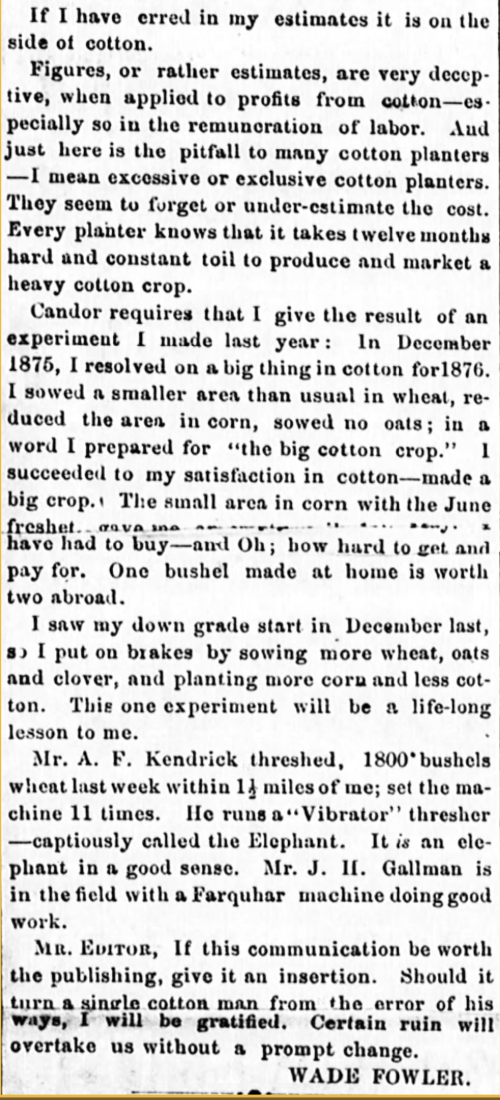
Dr. Wade Fowler was a leader in making the switch from cotton to wheat. His good standing in the community was rewarded with the good press he received from the local newspaper regarding his new farming methods.

The Union Times
Union, South Carolina •
Fri, Jun 15, 1877
Page 2
Dr. Wade Fowler wrote a letter to the Editor of the Union Times explaining the benefits of planting wheat rather than cotton. He gave estimates on producing both crops and compared the net profits.
His arguments were sound, and he gave an example of a neighbor who had much luck in making the switch from cotton to wheat. The doctor warned his readers of the ruin that would come if they did not rethink their farming practices.

The Union Times
Union, South Carolina •
Fri, Jul 13, 1877
Page 3
It was a brave move by Dr. Fowler. He stood up for what he knew to be true in spite of the old ways of farming. He was light years ahead of his time. Did his views make him popular? It seems not…….
Another letter to the Editor from a critique. If this was a reflection of how the majority of farmers felt about switching from cotton to wheat, Dr. Fowler no doubt lost some respect and popularity from his neighbors.

The Union Times
Union, South Carolina · Friday, July 27, 1877
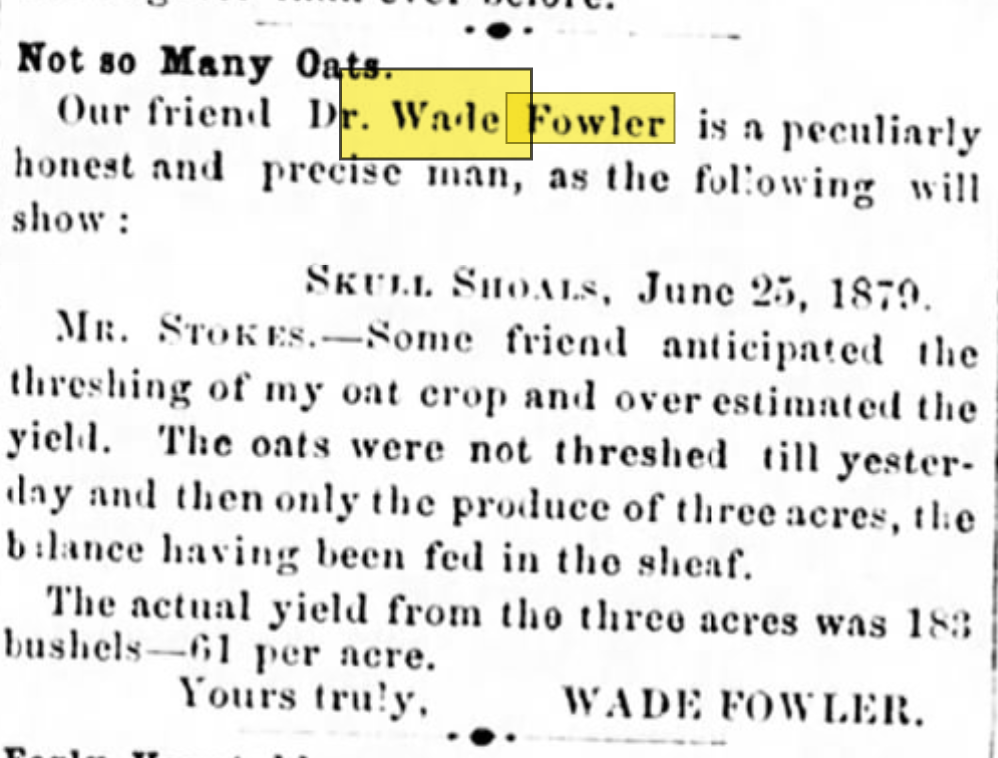
Two years later, Dr. Wade Fowler was still on his wheat-inspired soapbox.

Yorkville Enquirer
Thu, Jun 19, 1879 ·Page 2
The Union Times
Fri, Jun 27, 1879 ·Page 2
THE NEXT DECADE
The Wade Fowler family still lived at the home called Sunny Side in 1880. The doctor’s mother-in-law, Rachel Carothers, was seventy-five years old and had another decade ahead.
John C. Fowler, son of the doctor, had moved back into the family home. His occupation was listed as “Farmer” and he was twenty-eight years old.
Daughter Sallie Ross Fowler was not in this 1880 household. I do not find her in any census record, although I suspect that she was in school. Limestone School for Girls in nearby Gaffney was my first thought. I cannot find the names of the students for that school year, so I really don’t know.
It should be noted that there was a young black woman in the household working for the family. Her name was Carrie or Corrie, last name Thomson?

DR. WADE FOWLER IS DEAD
It was common, in the latter years of the 1800s, to read about the final illnesses of the local people in the South Carolina newspapers. It was not unusual to read that “So and So has been in bed from an attack of paralysis for several days” ” or “So and So was thrown from a wagon and is not expected to live much longer.”
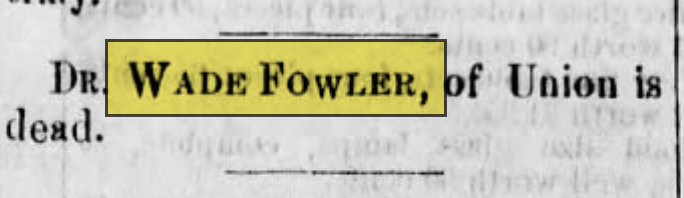
I find nothing to indicate that the doctor suffered from an illness or sustained an accident. It was somewhat of a shock to read Dr. Wade Fowler died on July 13, 1881. He was sixty-one-years old.
The announcement was short, abrupt, to the point. Was he still a respected man or had he ruffled too many feathers with his strong opinions on farming and other matters?
Dr. Wade Fowler was buried at Foster’s Chapel Methodist Church in Kelton, SC.
The Greenville News
Greenville, South Carolina •
Sat, Jul 16, 1881
Page 1
THE LAST WILL AND TESTAMENT OF DR. WADE FOWLER
The doctor signed his Last Will and Testament on his birthday, February 27, 1878. It was a well written document and made his wishes explicitly clear. Wife Elizabeth was left the Singer sewing machine; daughter Sallie was to inherit his piano; son John, his library and guns.
Elizabeth and both children were to share in the household goods, farming equipment, wagons, livestock, and the many acres of land Dr. Wade Fowler had acquired during his lifetime.
There was a provision for daughter Sallie to remain in school until her education was complete. I consider this evidence that explains her absence in the 1880 census: Sallie was still in school.
Elizabeth and her son John C. Fowler were named executors of the Last Will and Testament. Robert Howell, J. Rufus Poole, and Amanda Poole witnessed the document.

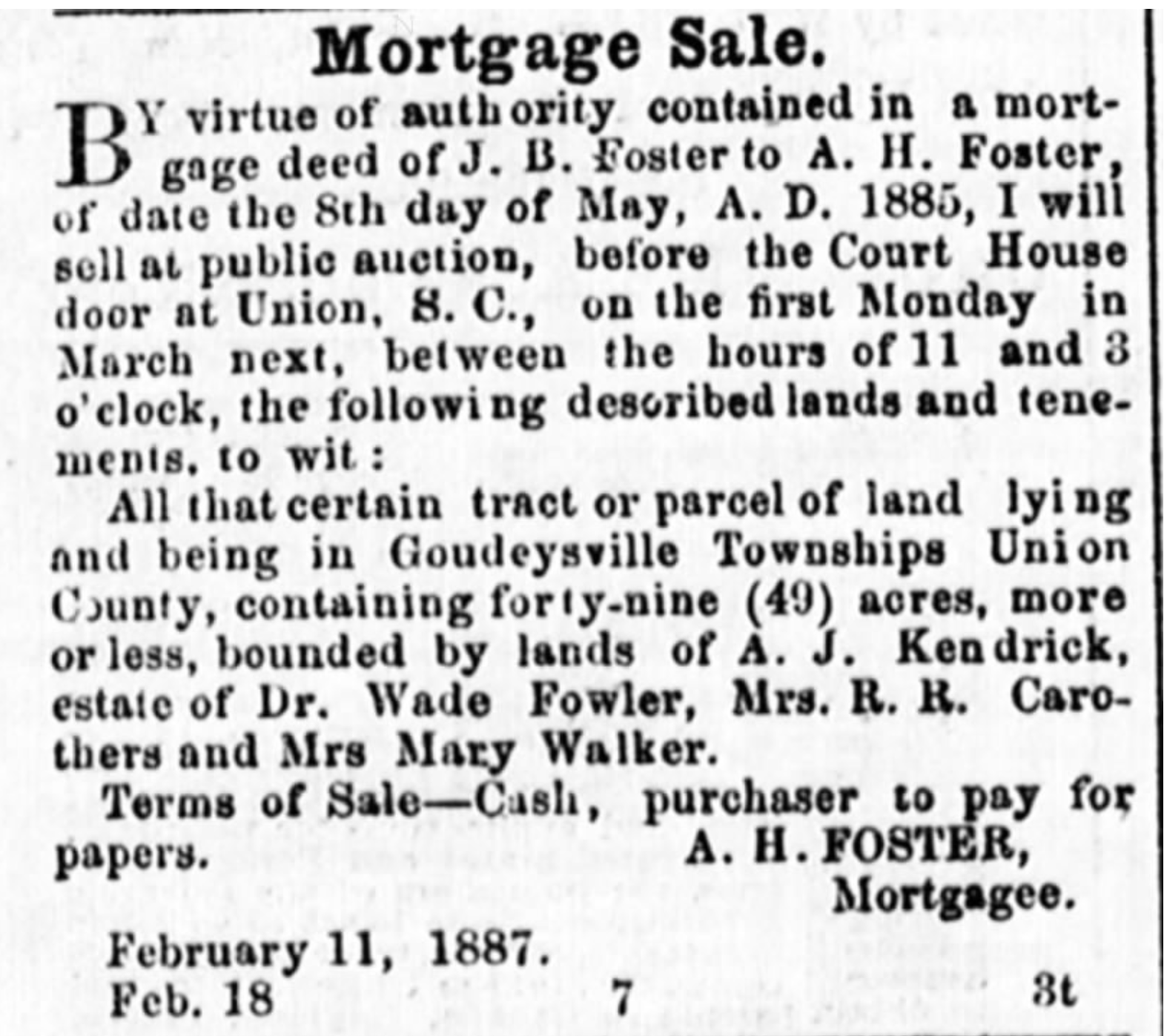
Speaking of circumstantial evidence, the mention below of a Mortgage Sale in 1887 links the name of Dr. Wade Fowler and A.H. Foster. It was with Alfred Foster, the merchant, with whom a John Fowler lived in 1870. It is my belief — based entirely on this small mention– that the John Fowler in the 1870 Foster household was John C. Fowler, son of the doctor.
The Union Times
Union, South Carolina •
Fri, Feb 25, 1887
Page 3
EIGHTEEN EIGHTY-FOUR WAS A VERY BAD YEAR
John C. Fowler died on October 8, 1884. HIs sister Sarah “Sallie” Ross Fowler died two months later, on December 16. Was there an epidemic in 1884 that took the lives of this brother and sister? Were their deaths related or was it only coincidence that both died within weeks of each other?
Their mother Elizabeth was surely grief stricken, her heart broken into a million tiny pieces.
I find no evidence that either John or Sallie married or had children. If that is so, then the line of Dr. Wade Fowler died with his two children.
There are three great monuments at Foster’s Chapel Methodist Church Cemetery standing guard over the graves of Dr. Wade Fowler, son John C. Fowler, and daughter Sallie Ross Fowler.

THE WIDOW FOWLER
Elizabeth Ann Carothers Fowler lost her husband and her two children within three years. What became of her?
She married A.W. Lotspiech of Gaffney, SC in 1886.
Her mother, Rachel Carothers, was bedridden in her home at Sunny Side. The state of her health was mentioned often in the local newspaper.

Yorkville Enquirer
Wed, Jul 31, 1889 ·Page 2
Her mother Rachel Ross Burrows died in 1890.

The Union Times
Fri, Feb 07, 1890 ·Page 2
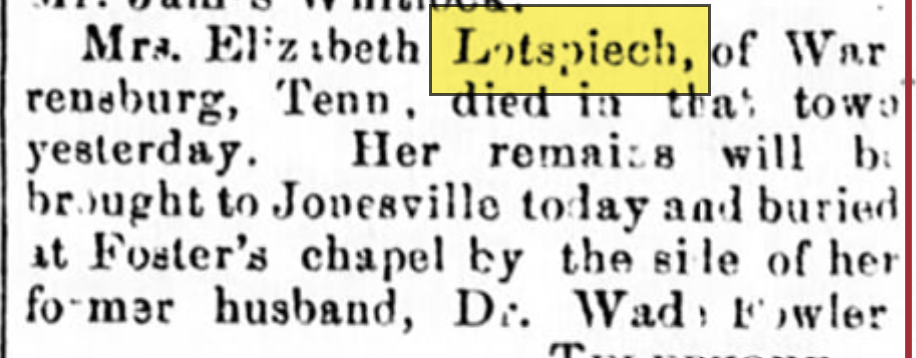
Elizabeth Ann Carothers Fowler Lotspiech died July 23, 1900 in Warrensburg, Tennessee while on a trip with her husband visiting his relatives.

The remains of Elizabeth Ann Carothers Fowler Lotspiech were taken to the grave yard at Foster’s Chapel Methodist Church and she was laid to rest near her doctor husband and the two children she had brought into this world.
The Union Times
Fri, Jul 27, 1900 ·Page 1
- HENRY ELLIS FOWLER (1746-1808)
- GODFREY FOWLER (1773-1850)
- JAMES FOWLER (1793-1858) m. SUSAN GAULT
- WADE FOWLER (1820–1881 m. ELIZABETH CAROTHERS
- JOHN C. FOWLER (1851-1884)
- SARAH ROSS FOWLER (1861-1884)
- FRANCIS G. FOWLER (1825–1866)
- IRVIN J. FOWLER (1830–1878)
- FRANK FOWLER (1831–1873)
- Baby Girl FOWLER (1834–1834)
- JAMES W. FOWLER (1838-1899)
- SARAH ANN FOWLER (1840-1925)
- SAMUEL WADDY FOWLER (1843-1861)
- WADE FOWLER (1820–1881 m. ELIZABETH CAROTHERS
- JAMES FOWLER (1793-1858) m. SUSAN GAULT
- GODFREY FOWLER (1773-1850)
 THE FOWLER FAMILIES OF UNION COUNTY, SC
Wonderful research and informative comments concerning this branch of the Fowler Family. Thanks for sharing!
LikeLike