To the boys who bore his name in the quiet years after the war —
Sons born into a nation learning how to breathe again.
They carried forward the memory of James Blake Steedman,
not through monuments of stone,
but through the simple, enduring act of naming.
This tribute honors those sons,
whose lives became the living thread
between remembrance and renewal.
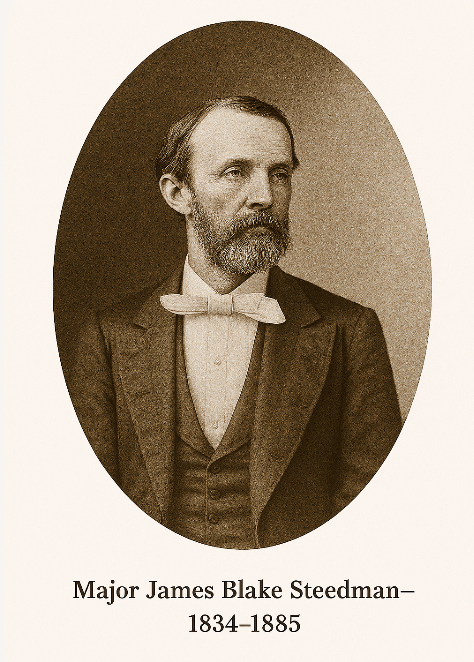
Major James Blake Steedman was born in Charleston, South Carolina, in May of 1834, a child of that old port city with its schools, steeples, and salt‑tinged air. His earliest lessons were learned there, in the place that shaped his first sense of the world, before he moved on to Columbia to continue his education at South Carolina College.
As a young man, he turned his attention to the law. Under the guidance of Mr. Tobin of Barnwell, he studied the discipline in the steady, traditional way of that era. In 1856 he earned his admission to the bar, a milestone that opened the door to the next chapter of his life.
Not long after, he set out for Union. He did not arrive as an unknown. Tucked among his belongings were letters of introduction to several of Union’s leading citizens. One in particular carried weight: a letter from his cousin, Col. Richard Yeadon of Charleston, addressed to Wallace Thompson—the father of Union’s beloved Dr. Wallace Thompson.
It was the kind of letter that spoke for a man before he ever spoke for himself. And so James Blake Steedman stepped into Union with his education behind him, his profession before him, and the quiet confidence of a man whose path was already beginning to take shape.
He married Miss Carrie Dogan in 1858, daughter of old Dr. Dogan, whose name once carried real weight in Union County households. They would have two daughters, Sue and Addie.
By the time the storm of secession broke, he was already counted among the ninety‑nine Union County men who stepped forward on January 5, 1861—just sixteen days after South Carolina left the Union—to form the Pea Ridge Volunteers of the 5th South Carolina Regiment. Their company flag, worn and treasured, still hangs in the relic room of the Union Carnegie Library.
Military service ran in his blood. His uncle, Admiral Charles Steedman of the United States Navy, had already set a formidable example, but he built a record of his own. Entering active service on April 12, 1861, as an orderly sergeant, he rose steadily through the ranks.
By August 29 and 30 of 1862, he was serving as major and commanding his regiment in the brutal fighting at Second Manassas. It was there he fell, grievously wounded, and would almost certainly have died on the field had it not been for the extraordinary care of a Virginia family who took him in.
The last surviving member of that household—a gentlewoman now seventy years old—told the story herself. Miss M. S. Delaplane of Delaplane, Fauquier County, Virginia, wrote with hands stiffened by rheumatism, determined to set down what she remembered.
She described how Major Steedman was carried from the battlefield and laid on wet straw in his tent as rain poured down, and how Dr. Thompson of Union, South Carolina, told him plainly that his wounds were mortal and his time short. Yet the Delaplane family tended him with a devotion that defied that grim prediction.
Maj. Steedman was accompanied in the field by a young servant named Bunyan, approximately eighteen years of age. His mother had long been associated with the Steedman household, and the boy entered service with a reputation for reliability and close personal loyalty.
During the period in which the Major lay severely wounded and in declining condition, he requested a small quantity of milk. Owing to the scarcity produced by the movement of troops and the requisitioning of supplies, Bunyan was unable to obtain any in the immediate vicinity.
He ultimately traveled a distance of eight miles, reaching my family’s home, before securing even a modest amount. Local residents had already surrendered nearly all provisions to the passing soldiers. What little remained in our possession was provided to him.
He stated that the message he received had stirred him so deeply that it “aroused all the bulldog in him,” and he resolved to make the journey despite his condition. He instructed Bunyan to secure an ambulance for transport. Dr. Thompson warned that he would not survive the trip, but he replied that he intended to try regardless. With the assistance of Dr. Thompson, Major Steedman’s brother‑in‑law Col. Dorgan, and Bunyan, he was placed in the ambulance and brought to the house.
Upon arrival, he was carried inside and laid upon a proper bed in a comfortable room. My four sisters, our mother, and I stood around him. Looking at us, tears running down his face, he said, “Ladies, your message came to me as one from Heaven,” contrasting the clean room and soft bed with the wet straw and tent he had left behind.
We immediately sent for our family physician, Dr. Leach. When he arrived, he had the wounded man bathed and dressed in a clean nightgown, as his clothing was soaked with blood. Dr. Leach then conducted a full examination and reported that the collarbone was broken, the bullet had passed through the left lung, and it had lodged in the spine, leaving his legs completely paralyzed.
Dr. Leach set the Major’s broken collarbone with practiced care, and my oldest sister, Mary, climbed onto the bed behind him to sew the bandage in place. Sensing her unease, the Major tried to lighten the moment. “When I was at home,” he said, “we used to have private theatricals, and I always took the part of the lady. I reckon I will do so now.”
Then, turning to my mother with a gentleness that belied his suffering, he added, “I would like to call you Mother—my own mother is in Heaven.” From that moment forward he addressed her as such, and he called the rest of us his sisters. It was a bond we honored. From that day on, we nursed him in turns—two of us each night—while Bunyan kept close at hand.
Weeks passed, then perhaps months. In time the bullet shifted into his bowels, bringing him terrible pain. His abdomen swelled so greatly that he could not bear even the weight of a sheet; only the thin cambric gown could rest upon him. After many more weeks, the ball moved again, settling into his left side, where it remained until his death in 1885.
After the ball finally worked its way out of the spine, he regained a faint sense of feeling in his legs, though he could make little use of them. We fed him as one would tend an infant, for he could not lift a hand to help himself. Through all of it—through the pain, the helplessness, the long uncertainty—he remained the most patient sufferer I have ever known. Not once did he murmur or complain.
He became, in those months, one of the dearest men any of us had ever known, and we loved him as we would a brother.
Slowly, almost imperceptibly at first, he began to improve. By January—so far as I remember—his wife arrived, and together she, Col. Dorgan, and faithful Bunyan prepared to take him home. (The battle in which he received his wound—the Second Battle of Manassas—had been fought on August 29 and 30, 1862.)
“We heard from him often and after two or three years he came to see us, bringing his wife and her sister, Mrs. Humphries, with him. He was then using two canes—when he left us he used crutches. Afterwards he came to see us every summer, bringing his daughter, Addie, with him.
Despite his lameness and this minne ball embedded in his body, Major Steedman led an active life and was one of Union’s most zealous and helpful citizens, serving as ‘Intendant’ of the town and always taking a deep interest in whatever tended to the betterment of its conditions.”
The story of his success at the Bar is told by the ‘In Memoriam’ in other columns of this paper. It can only be said here that no one who knew him ever failed to find something to admire in his life and character.
To what he called the ‘bull dog in him,’ Capt. F. M. Farr gives this testimony. ‘Major Steedman had more real “grit” than any man I have ever known. I was associated with him in some very complicated business matters. It was always his custom to carefully study a subject and decide what was right—that done no power could move him.
Once a reckless fellow got mad at him, rushed into his office and aiming a pistol at him cried, “I am going to shoot you.” Looking up without the quiver of a muscle, the Major said cooly, “Shoot, I’m not one bit afraid.” The hand that held the pistol lost its nerve before the calm, quiet countenance and fell to the holder’s side.
One of the most comforting and beautiful things in the life record of this perfect gentleman, brave man, and gallant soldier is that he was a Christian.’”
“On Jan. 31, 1863 the Record of the Presbyterian church, Union, S. C., states that ‘Mr. James B. Steedman on examination was received as a member of this church. Rev. Henry M. Dickson, moderator of the session. Elders William Perry and C. Gage being present.’
Because of his weakness Major Steedman could not attend the communion services and Rev. William Dickson, with the elders mentioned, held a service for him at the residence of Dr. Dogan.
Abram, the carriage driver, a slave around the Dogan family, earnestly begged to be allowed to take the communion with the Major. This request was granted and he sat beside the cot on which the Major was lying and received the elements as they were passed from the Major’s hand.
On March 19, 1881, his wife, Mrs. Carrie Dogan Steedman, died and was buried in the Dogan plat at the ‘village cemetery’ close beside the little daughter, Sue, who had died in 1865 at the age of 4 years.”
The only remaining child, Miss Addie Steedman, developed into a young woman of fine character and charming personality. In 1882 she was married to Capt. Thomas Thorpe, of Virginia, and in 1883 Major Steedman spent some time with her and her husband and they made a trip by carriage to Luray Springs, revisiting much of the country through which he had marched and fought in the ’60’s.
Early in 1884 he was married to Miss Susie Harrington of Virginia and in December of that year Mrs. Steedman went to spend the Christmas holidays in Brooklyn, N. Y., with her parents who were visiting there. She contracted pneumonia and died during the holidays. Major Steedman was with her during her illness and after her death returned to Union by way of steamer to Charleston.
In some way he contracted a severe cold and when he reached Union was very ill. Pneumonia set in, the old wound became inflamed and very soon his condition was serious. It was not the day of trained nurses and friends watched by his bedside. S. M. Rice was reading law in his office at the time, and the Major asked for his constant presence with him during the day, having him act as an amanuensis and take down business notes at his dictation.
The night watches were kept by special friends of the sufferer, Judge Townsend, William A. Nicholson, David Johnson and Rev. B. G. Clifford taking turns in this loving service. One night when Dr. Clifford sat beside the Major was wakeful and in the midnight said, ‘You are my pastor and I want to tell you that I should be glad to die, but if the Lord wishes me live, I bow in submission to His will.’
The last week of his life Judge Townsend did not leave him and when the summons came to him in the early watch of the morning 1885 his sister leaned over him and whispered, ‘Brother the Everlasting arms are underneath.’
With a peaceful smile upon his pallid lips he murmured ‘The Everlasting—arms—are underneath.’ and those arms enfolded his weary spirit and bore it into the presence of the Father and his God.
The day before Major Steedman was called to his rest, a little son was born to his daughter, Addie, and they gave the baby boy the name James Steedman. The mother died soon after, but the boy has grown to be a man and is an electrical engineer in Virginia, whose friends think in some degree at least worthy of the grandfather whose name he bears.
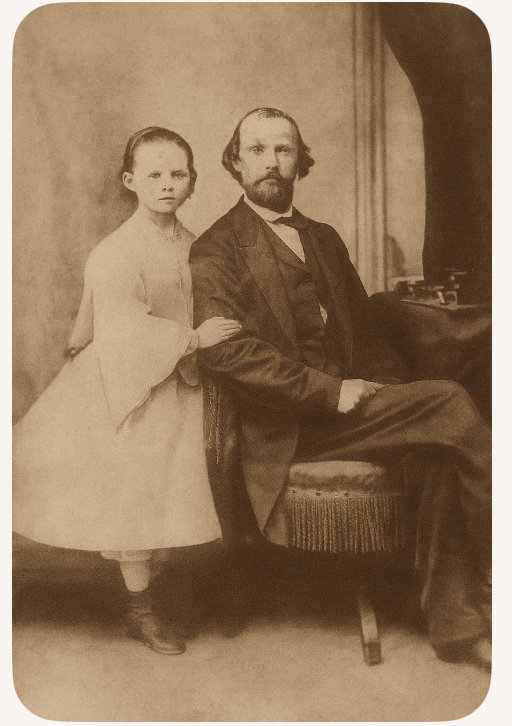
Transcribed and embellished from the The Union Times; March 20, 1914
 THE FOWLER FAMILIES OF UNION COUNTY, SC