Thomas J. Fowler married Orpha Kennett on January 19, 1864.
The marriage likely caused this Confederate Soldier to lose rank in his regiment. Nonetheless, there was a happily-ever-after ending. Thomas J. Fowler survived the war, and he returned home to his bride.
I cannot state with any certainty the name of the man who fathered Thomas J. Fowler. Was he Andrew Fowler (1804-after 1870)? If so, I still do not know the Fowler family line from which Thomas J. Fowler descends as the origins of Andrew Fowler have long been a mystery to me.
My belief that Andrew Fowler was the father of Thomas J. Fowler is speculation based entirely on location.
The Andrew Fowler family lived in Union County in 1850, and the household included sixteen-year-old Thomas:
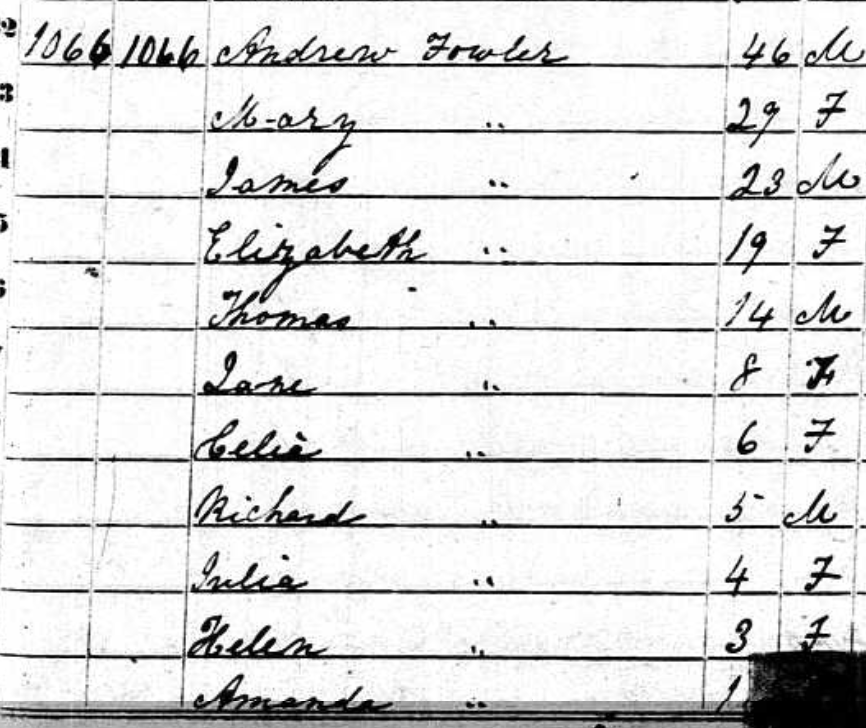
Twenty-five-year old Thomas Fowler was in the 1860 household of his father Andrew Fowler. They lived in the Goudeysville section of Union County, north of the Pacolet River.

My disclaimer: I DO NOT know if the Thomas Fowler in the 1870 Cherokee County Georgia census is Thomas J. Fowler. The census taker may not have understood the wife’s name and may have recorded her as Dolphus rather than Orpha. It’s unlikely but I’m grasping at straws.

This theory has weak support. The three people on this census record —Thomas, Dolphus, and Johnson Fowler — all hailed from South Carolina. That’s all I got.
Thomas J. Fowler was listed in the 1880 Union County, SC census with his wife Orpha. A census taker with bad handwriting wrote her name as “Artha“.

And, here is where location comes into play: Thomas J. Fowler and his wife lived at Draytonville in Union County. It is located north of the Pacolet River where the Andrew Fowler family lived.
It’s not real evidence, maybe just a coincidence, but it does put Thomas J. Fowler in the vicinity of where Thomas, son of Andrew, grew up.
We have two census records with a Thomas Fowler in the household of Andrew Fowler. There is also one record with a Thomas Fowler and a wife named Dolphus in Georgia. Finally, there is the Thomas J. Fowler in the 1880 household with his wife Orpha Kennett.
Were these three different men, or was this our Thomas J. Fowler hiding in plain sight? I don’t know.
Do not despair. I can follow Thomas J. Fowler through the years 1861 to 1865 before the big leap to the 1880 census, for Thomas J. Fowler was a soldier in the Confederate Army!
It took a little sleuthing to discover that the Thomas J. Fowler who married Orpha Kennett was known as T.J. Fowler in military records.
T.J. Fowler joined Company B of the 17th Regiment of the South Carolina Infantry. Like many men in the south, he initially enlisted for twelve months.
“One southerner can whip ten Yankees” was more than a catch phrase. The people of the south believed that they would win the war, and do so quickly.
As the battles dragged on and on, days turned in weeks, and months turned into years. Thousands of men from both north and south would be hastily buried in shallow graves beside bloody battlefields. The women and children left back home would have to find a way to survive, their world forever changed.
Below left: the Header Card for T.J. Fowler with both Corporal and Private as his rank.
Below right: the Company Muster Roll with his enlistment on December 14, 1861 at Camp Hampton near Columbia.


Below left: T.J. Fowler was admitted to the General Hospital at Camp Winder near Richmond, Virginia on August 29, 1862. His ailment was Dysentery. He was furloughed on October 15, 1862 for twenty days.
Below center: T.J. Fowler was paid $50 Bounty on October 15, 1862. His rank appears to be Sergeant.
Below right: Furlough was granted for thirty days on October 16, 1862. His rank was listed as Private.
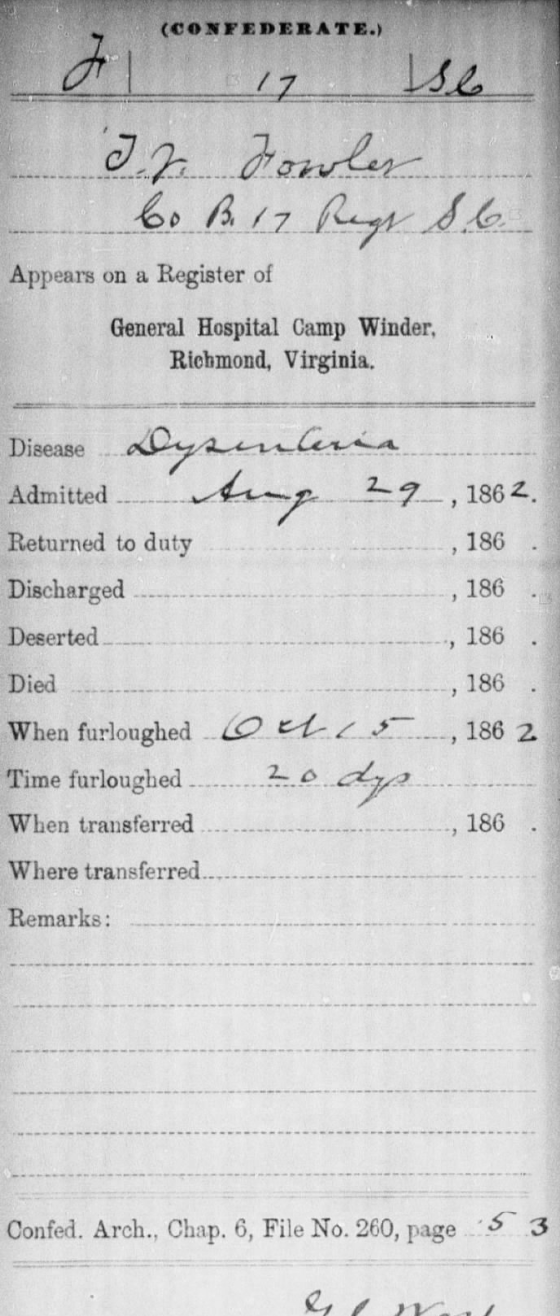
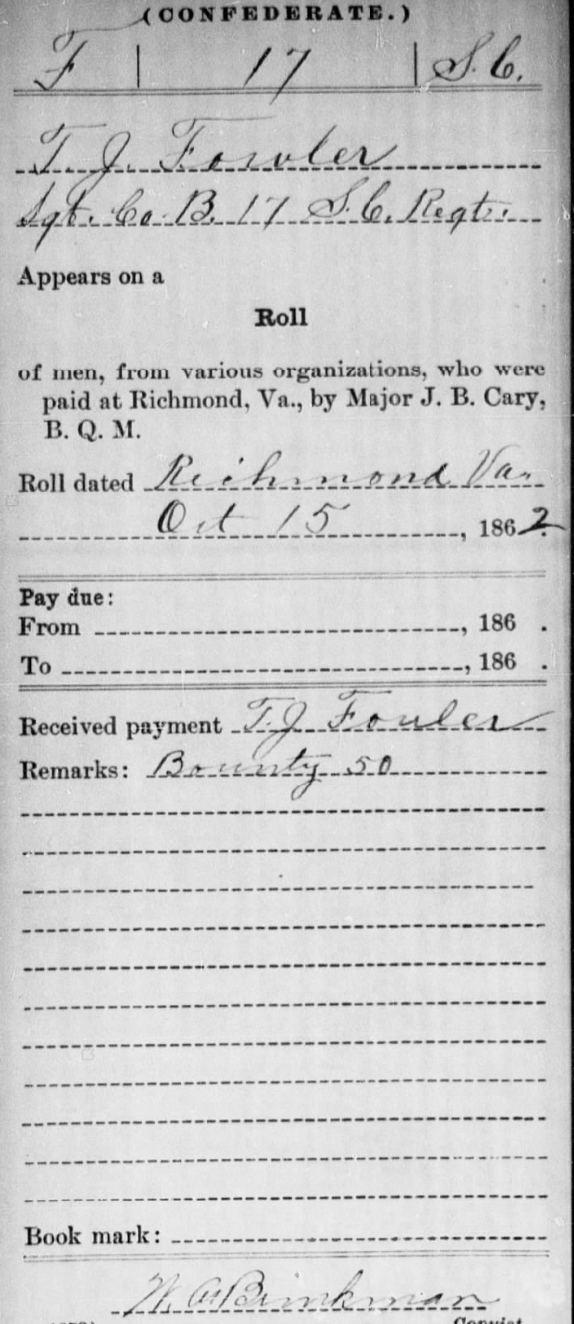

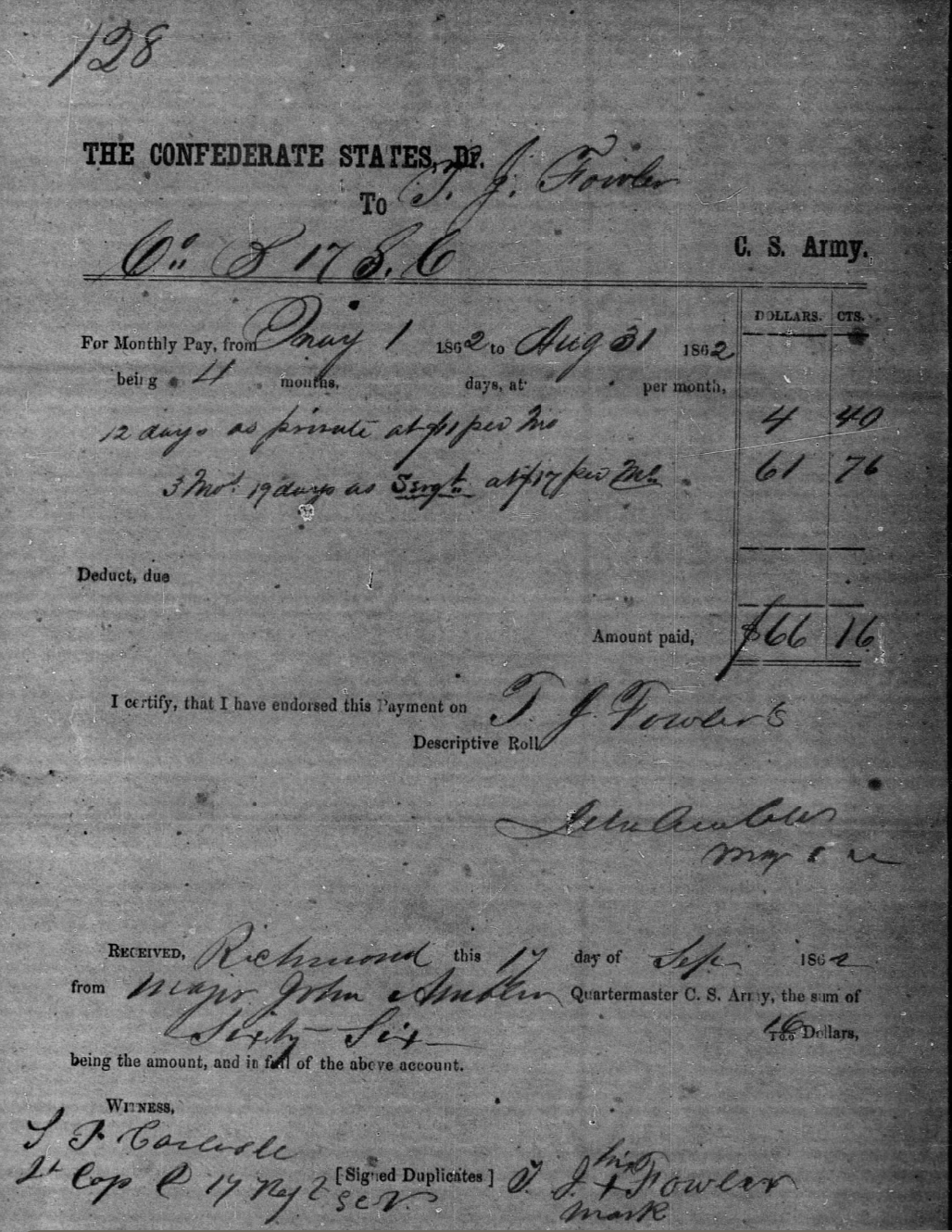
The two interesting military documents below detail the breakdown of T.J. Fowler ‘s pay for four months service from May 1, 1862 until August 31, 1862.
A typical soldier (a private) in the Confederate Army was paid $11 per month. Think about that for moment: 37 cents a day!
A non-commissioned “buck” (newly appointed) sergeant with added responsibility and duties received 57 cents a day. This amounted to a grand total of $17 a month. This pay structure would be in place until almost the end of the war.
T.J. Fowler received $4.40 for 12 days served as a Private in his company, and $61.76 for 3 months, 19 days as a Sergeant. The total was $66.16.

Below left: The November/December 1862 Company Muster Roll states that T.J. Fowler had been last paid for service through August 31, 1862 at the hospital. He was “absent, at home on sick furlough extended by private physician.”
Below center and right: January/February 1863 and September/October 1863 Company Muster Rolls indicating that T.J. Fowler had recovered from his illness and was “present” in his regiment.

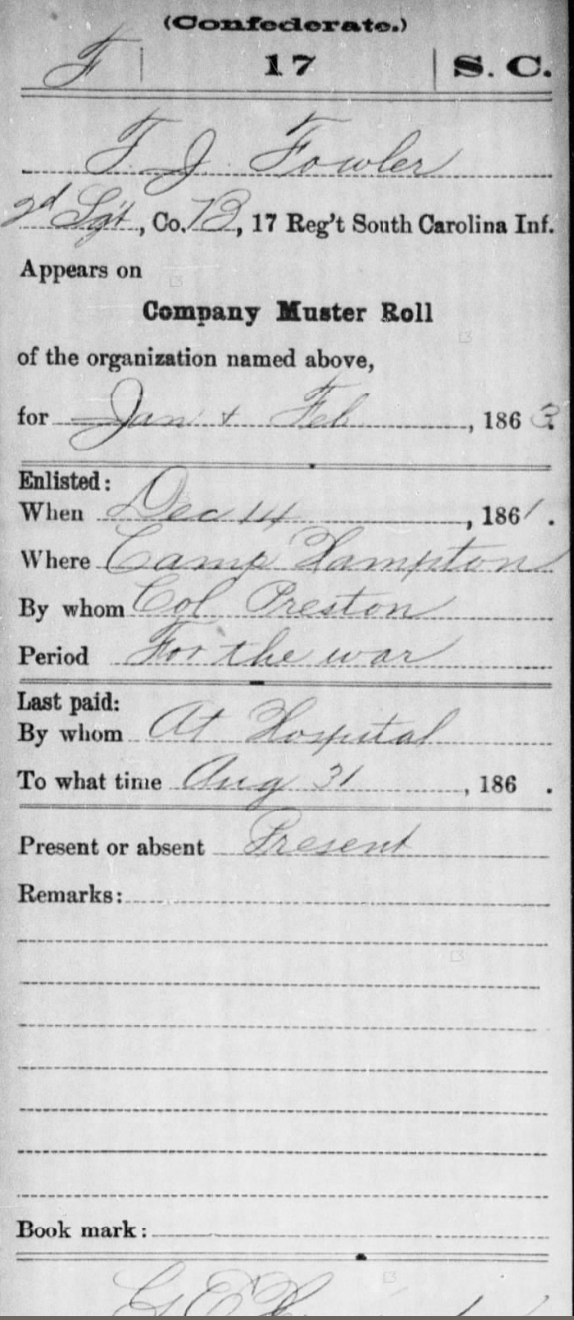

The following document was most important in establishing the identity of T.J. Fowler. My first step was weighing the odds that the “T” stood for “Thomas.”
Next, I had to sort through all of the Thomas Fowlers who were old enough to join the Confederate army.
The clue in contained in the November/December 1863 Company Muster Roll was the genealogy jackpot. T.J. Fowler was “absent on marrying furlough since December 22; 15 days.“
I knew from my research that a Thomas J. Fowler had married Orpha Kennett on January 19, 1864. Now it all made sense. Thomas J. Fowler was T.J. Fowler and he had been granted furlough to go home to marry. He and Orpha married 28 days after he left his regiment.

Below left: Thomas J. Fowler kissed his bride good-bye and returned to his regiment. He was counted as “present” in the January/February Muster Roll.
This document also shows that First Sergeant T.J. Fowler was reduced in rank to Private T.J. Fowler on January 22, 1864. Was this demotion was due to overstaying his marrying furlough, or did he ask for a rank with less responsibility?
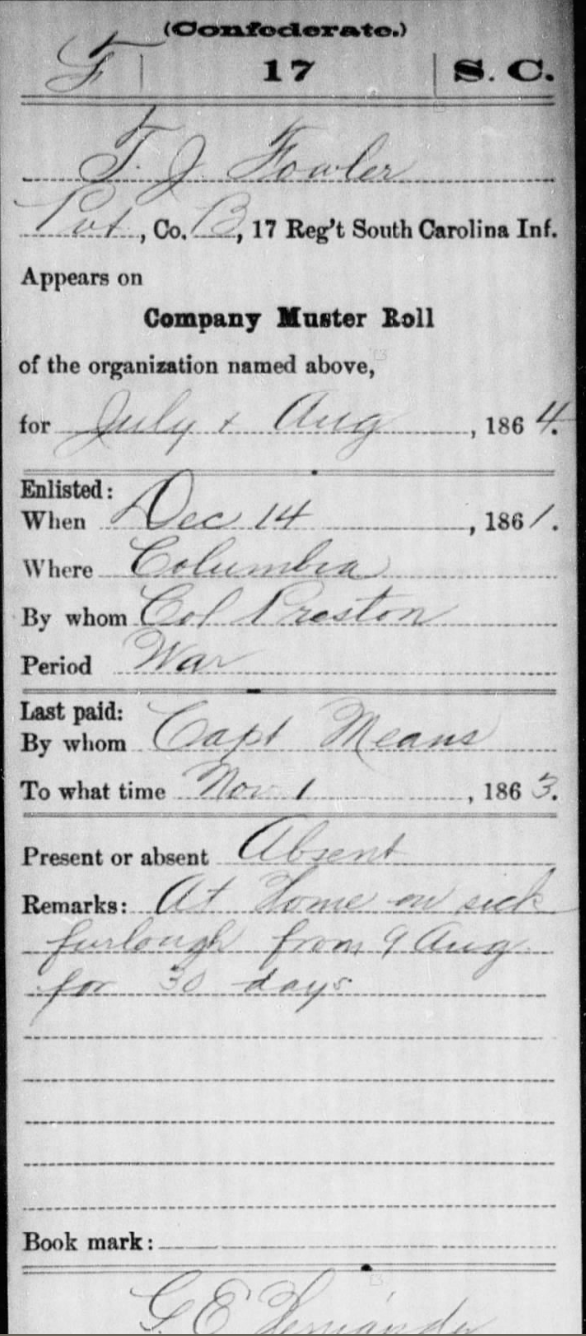
Below center: Private T.J. Fowler was “present” for the March/April 1864 Company Muster Roll.
Below right: “at home on sick furlough from 9 August for 30 days.”


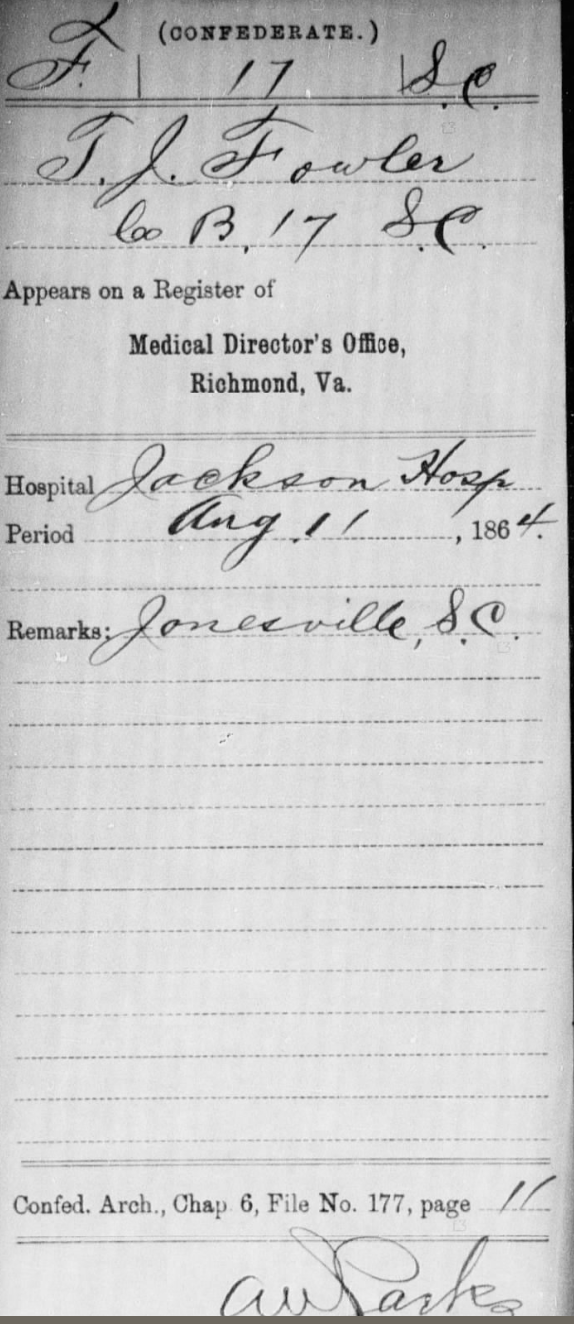
The documents below are proof of his admission to the Jackson Hospital in Richmond, Virginia on August 6, 1864. His illness was Diarrhea and fever. He was given furlough for 30 days. Jonesville, SC was his destination.


Below left: A passport was issued from the Jackson Hospital on August 12 giving T.J. Fowler permission to travel home to Jonesville SC.
Below center: T.J. Fowler was back in time to be counted as “present” in the September/October 1864 Company Muster Roll.
Below right: T.J. Fowler was “absent, sick at Brigade Hospital” during the November/December 1864 Company Muster Roll. Disease claimed more lives than bullets in this war.


Below left: T.J. Fowler was absent during the January/February 1865 Company Muster Roll. He was on “detailed service by order of General J. Johnson since February 12, 1865.”
Below right: Thomas J. Fowler was there in his Regiment when General Robert E. Lee surrendered at the Appomattox Court House on April 9, 1865. Feelings of defeat, despair, and dejection were surely mixed with feelings of relief that the long war was finally over.


Thomas J. Fowler returned home to his wife and it is known that he lived for at least fifteen more years. He died sometime after 1880.
His widow, Orpha Kennett Fowler, lived with her nephew James Milton Kennett and his family in 1900.
Orpha Fowler’s name was printed in the local newspaper on the Confederate Pension Roll in 1903. The pension she received was $17.35, more than the $11 her husband had made as a soldier in the line of fire.
Most undocumented on-line family trees show her death in 1915. However, her name was on the 1915 and 1918 pension rolls.
I have not found death or burial information for either Thomas J. Fowler or his dear Orpha. I walk among the many field stones scattered in-between the engraved headstones at Gilead. I imagine that I may be passing by their final resting place.
It is my hope that they are together.
 THE FOWLER FAMILIES OF UNION COUNTY, SC
Thanks for all your time spent on research!
LikeLike