Grindal Shoals.
If you are a Revolutionary War buff, you will recognize these two words, and you will know what happened there so very long ago. If you are not a big fan of American history, the two words will mean nothing to you and will not be given a second thought.
It was here that Revolutionary War General Daniel Morgan and his troops camped from the 25th of December 1780 for twenty days. The decisive Battle of Cowpens that changed the direction of the war was planned here.
The shoals at Grindal provided an important crossing before, during and after the war.

There has been much written about the historical importance of the area around Grindal Shoals during the Revolutionary War.
I am not going to repeat what has already been said.
Instead, I am going to put pen to paper and tell of the men, women, and children who lived there the past two hundred and seventy years.
Rather than another history lesson, my story will be one of a more personal nature.
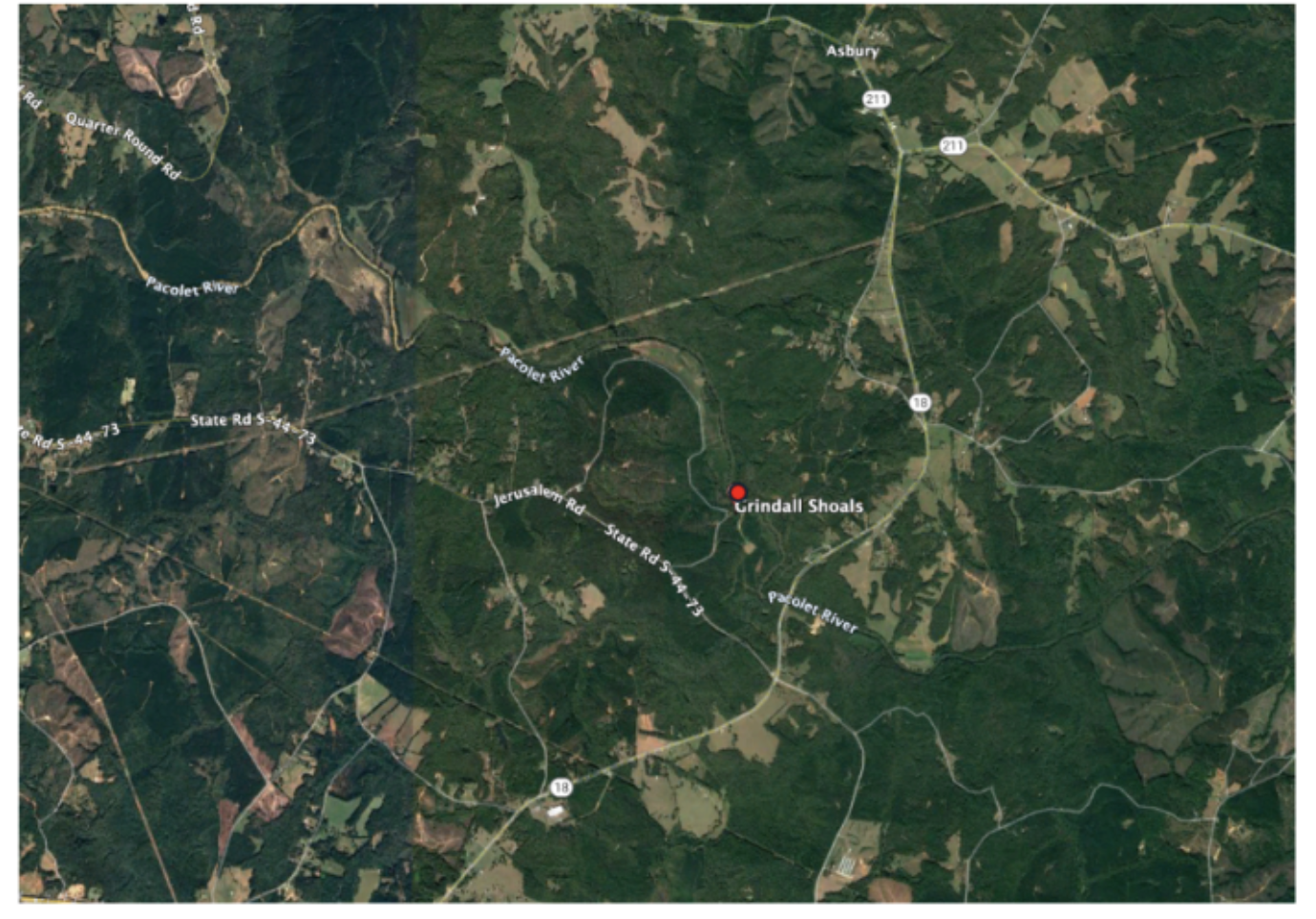
Grindal Shoals is located on the Pacolet River about 5 miles — as the crow flies– a little north and slightly east of the small, sleepy town of Jonesville, South Carolina.
Now a land of mostly forest and wildlife, Grindal Shoals was a thriving, social community her early days. Heroes of the Revolutionary and Civil wars, politicians, an artist, plantation and mill owners, lawyers, a future governor of South Carolina– many prominent people lived on the banks of the Pacolet.
My family —Fowler, Foster, Littlejohn, and Hames — lived near the shoals in the 1800s. My family hunted the land in the 1900s. I have family buried there. Grindal Shoals is near and dear to my heart.
HOW THE SHOALS GOT ITS NAME
I have seen information on two independent websites stating that the shoals were initially named Carroll Shoals after Richard Carroll who moved into the area around 1751, obtaining a land grant in 1752.
I find no evidence of Richard Carroll at Grindal Shoals after 1752. There are records of Richard Carroll in Craven County in 1763-1765; in-between the Broad and Saluda Rivers in 1779-1780; and in Laurens County in 1790. I do not know if this was the same man as Richard Carroll of Grindal Shoals.
Carroll Shoals became Grindal Shoals after John Grindal came to the area circa 1755. My research shows that he obtained land as follows:
- 1768: 80 acres granted by North Carolina Governor Tryon
- 1774: 100 acres by a deed from James Huey (Hughey)
- 1775: 250 acres by a land grant
- March 1, 1775: 150 Acres On Pacolet River, Originally Granted By The Governor Of North Carolina nn April 25, 1767. Places in this record: Carrol Shoal; Pacolet River; Swift Shoal
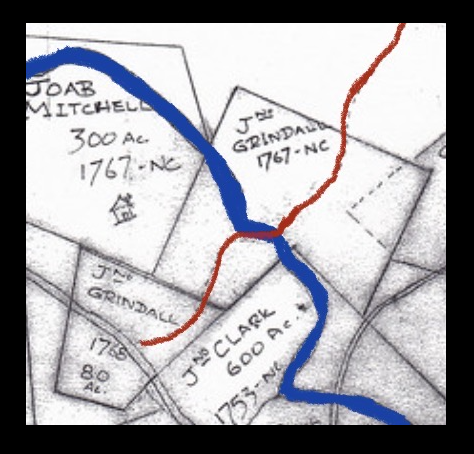
This acreage spanned both the north and south sides of the Pacolet River, and it was here that the solid rocks of the shoals provided a safe river crossing. (Pacolet River in blue; Grindal Shoals crossing in red)
Other pioneer families followed John Grindal, and settled along the banks of the Pacolet.
I have researched these families of the shoals for many years. I have studied maps, land grants, land transactions, census records, newspaper articles from long ago, state archive records. My research is ongoing.
I was recently asked by several people at a historical meeting if I knew who has lived at Grindal Shoals throughout the years. I shall do my best to answer.
The early people of Grindal Shoals came from Virginia, North Carolina, Pennsylvania, and New England. They were primarily of Irish and English descent. Many families traveled there with extended family; some came alone.
THE FIRST FAMILIES OF GRINDAL SHOALS
Cherokee Indians were the first families to inhabit the area known to us as Grindal Shoals. Once they were pushed out
Richard Carroll was the first known white settler to claim land along the River Pacolet, followed by John Grindal. The land was lush, abundant with wildlife and crossed by the many creeks that flowed in the river. It did not take long for others to discover this paradise.


SARAH ADELINE SIMS
Many influential men and women called Grindal Shoals home in the years to follow, but I believe that the most important treasure to come out of Grindal Shoals was in the form of Miss Sarah Adeline Sims (1828-1906). She was the daughter of Joseph Stark Sims, she was called “Addie” by her family and close friends, and she lived most of her life on the south side of the Pacolet River.
Addie Sims was a remarkable woman –intelligent, educated, cultured, and talented. She left us written histories of the land and the people of Grindal Shoals. She was an artist who who painted landscapes of the area around the shoals; and beautiful, wonderful images of her people, both family and the enslaved.
Addie Sims gave us the first descriptive narrative of Grindal Shoals. She may not be credited as the first, as others paraphrased her words and published “their” work into books, one being the History Of Grindal Shoals and Some Early Adjacent Families by Rev. J. D. Bailey, published in 1927.
Addie Sims said it first, and best. She was there, living at Grindal Shoals in its heyday, in the very best years of the shoals when the area was prosperous and populated by the most cultured, ambitious, industrious, and educated people in the upstate.
The paragraphs below in italic were written by Addie Sims on December 1, 1894, and published in three parts in The Union Times on May 24, May 31, and June 7, 1895, and again in The Gaffney Ledger on June 2, 1916:
SOME INTERESTING HISTORY
Grindal Shoals is not unknown to all who are familiar with the history of South Carolina. It was on the north side of Pacolet, at Grindal Ford, that Morgan camped just before the battle of Cowpens. The place is described by John Kennedy in his famous novel, “Horseshoe Robinson.” In the very earliest settlement a family by the name of Grindal lived on the north side, owning the shoal, which was a noted fishery, and from them, it was called Grindal Shoals.
How the little river got the name of Pacolet has always been a mystery to us. Pacolet in its origin is French and is found in an old ballad written in the time of Pepin, familiar to us all as a nursery rhyme — “Valentine and Orson.” Pacolet means swift messenger and this was once a swift little stream. We well know that our old frontiersman had no acquaintance with literature, and it is yet unknown to us who named the river. It was called Pacolet long before Walter Scott introduced Nora of the fitful head and her dwarf attendant to the reading world.
ALEXANDER CHESNEY
The earliest settlers known to us were families from Virginia and North Carolina, who moved here prior to the Revolution. One Chesney, an Englishmen, was probably one of the earliest settlers. Chesney owned a large grant of land on the north side of Pacolet river extending above for several miles below Grindal’s Ford. When the war came on he was more grateful to George the Third than some of us who accepted his gifts. Chesney adhered to the Royalist side and it was soon made too hot for him about here. He fled to Charleston and escaped to England.
Major Chesney, of the English army, who was in Virginia during our Confederate war, and ardent admirer of General Lee and sympathizer with the South, was a descendant of this Chesney, who once lived on Pacolet. Major Chesney discovered amongst his ancestor’s old papers a diary which he kept during his residence here and which contains an account of the rude way in which the “rebels” forced him to leave the country.
JOHN NUCKOLLS
John Nuckolls came from Virginia with his family about 1767 and settled a place on Thickety, afterward known as Whig Hill. There also came a brother of Mrs. Nuckolls, Major Zachariah Bullock, of Virginia, who owned a grant of land on the north side of Pacolet three or four miles above Grindal. This place remained in possession of the Nuckolls and Bullock descendants until very recently.
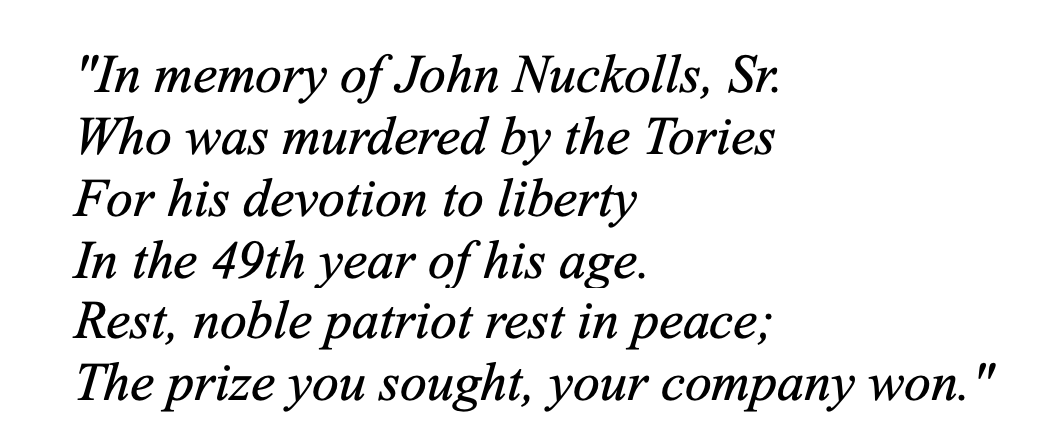
It was the property of Miss Julia E. Norris and her nephews, Frank and Will Anderson, the sons of Major F. L. Anderson, of Spartanburg. They sold the place and moved to Tennessee. It was the same John Nuckolls, mentioned above, who was murdered by the Tories for his devotion to liberty and whose tombstone bearing the following inscription may be seen today in Whig Hill cemetery:
THE GOUDELOCKS
Then came the Goudelocks. The Goudelocks were from Rock Fish, Albemarle, Virginia. They lived before and during the Revolution at a place since known as the homestead of Major Elijah Dawkins, now the home of Mr. Durbin Littlejohn. This place is on the north side of the river above Grindal Shoals.
WILLIAM HENDERSON
William Henderson came prior to the war and owned a large grant of land on the south side of the river. John Beckham and family followed and settled on part of the Henderson grant. Mrs. Beckham was a sister of Henderson. At the beginning of the Revolution, William Henderson joined Sumter, who was an old friend and at the battle of Eutaw Springs was severely wounded. It was after this engagement that he was made general. The war over, Henderson married and settled on the Santee.
About 1784 Major John Henderson moved from Halifax, North Carolina, bought the whole grant of land from his brother, General William Henderson, and settled a place a mile from the shoal on the south side. William and John were the younger sons of Samuel Henderson and Elizabeth Williams, and brothers of Richard Henderson, the last Colonel Judge of North Carolina, all from Granville County.
The gallant Colonel Williams, of Kings Mountain, was first cousin to the Hendersons. Major John was a fine old character, greatly beloved by all of his neighbors. His wife was a Mrs. Alston, of Halifax, North Carolina. The Henderson house is still standing and when one views is very limited accommodations one wonders where they stored away all the guests who visited the hospitable old gentleman.
ADAM POTTER
Mr. Adam Potter owned a beautiful plantation on the south side above the ford, known as Nott place. Mr. Mitchell and Mr. Hale, brothers-in-law to the Hendersons, lived nearby.
WILLIAM HODGE
Above the Potter place on the river lived William Hodge and family. Hodge was an honest, brave Whig who fought all through the war and was at the battle of Cowpens. The family suffered greatly from the marauding, thieving, house – burning Tories. This house was burned with all the family’s possessions. The old place was still owned by one of the descendants until very recently.
The late Reverend James Hodge, Sr. of Fishing Creek Church, Chester, South Carolina was related to this family. All of these were good old families with as much education as the times afforded, and brought with them the courteous manner, habits and tastes that belonged to an older civilization. Hence the settlement around Grindal Shoals was always known as a neighborhood of more culture that was often found in the backwoods of Carolina. It was really the cradle and nursery of many who afterwards filled high positions.
THE HAMPTON BOYS AND THE BECKHAM FAMILY
Wade and John Hampton in their early youth were familiar characters about Grindal, where they came to hunt and trap fur animals. These youths were always the guests of Mrs. Beckham, her husband, John Beckham being also fond of hunting.
During the Revolution John Beckham was a noted scout and was often employed by Hampton to serve the cause of liberty in this capacity. So the friendship was kept alive. The war over, Hampton had risen to high distinction and was acquiring great wealth, but he still kept in touch with his old friend, Jack Beckham, who was a “ne’er-do-well.” Hampton gave Beckham employment as a trainer of race horses.
Jack died at last and left Mrs. Beckham with a house full of daughters and very poor. And looking over her husband’s accounts, Mrs. Beckham found that there were something due her husband’s estate from Hampton, so she resolved to visit him and see what he could do for her.
The family and friends advised against this, saying that Hampton was now a very rich and distinguished man living in grand style in Columbia. The old lady, however, replied that she would trust him; that she had known “Wade“ in his youth, that her house was then open to him and she could not believe that he would forsake her now.
She mounted “Derrick,” her famous old horse, and set off for Columbia all alone. She made the trip safely, and on her return the family gathered around her eager to hear the result of the visit. Mrs. Beckham was exultant.
“How did he receive you?” was asked. “Receive me? He received as if I had been a queen. And nothing in his grand house was too good for Mrs. Beckhan. Child, I was put in a fine chamber with a great mahogany bedstead covered with a canopy, and so high that there were steps to climb into it and they were carpeted. He paid me and more than paid me.”
So I suppose that the dear old lady returned with more money in her pocket and she had possessed in many a day. This was told me by my mother, who is a great niece of Mrs. Beckham, and I record it as illustrating the character of the grand old men who made Carolina what she once was.
A LAND OF SYLVAN BEAUTY
This new land in its sylvan beauty, must have been a paradise to the first settlers. With fish from the stream, game from the woods, flocks of wild turkeys at their very doors, living was certainly easy even for the poorest.
From tradition I gather that this old community were a “convivial set,” and enjoyed their gatherings for feast and revel. Of dancing I know they were particularly fond. Major John Henderson and Miss Sally Goudelock, arrayed in blue silk and diamond necklace, would lead off in the stately minuet and doubtless “slow step, coupe, sink and rebound” were as gracefully performed then as now. And Mrs. Potter’s agility in the execution of the forty-nine steps of “Old Roger de Coverly” was the admiration of the country. Later on came Mr. Adam Knott, a young lawyer from from Saybrook, Connecticut, who married Miss Angélica Mitchell, the niece and adopted daughter of Mrs. Potter.
Major Henderson had two daughters, Elizabeth and Sarah. “Betty” as Elizabeth was usually called, married Mr. Henry Fernandez from Fort Tobacco, Maryland, who is a merchant and opened a store near the ford. Sallie married Mr. Ben Haile.
ATTORNEYS AND A GOVERNOR
Young David Johnson lived here and read law under Mr. Nott. Also young William Henderson, son of Major John Henderson. Henry Bailey, from Virginia, lived about here for some time. He was a fellow student of Lemuel Alston in William and Mary College, Virginia, and came here after his graduation with young Alston.
Mr. Bailey was a great favorite, a genial companion and an accomplished gentleman. He taught school for a while, afterword went to Charleston, studied law and settled there. His son, Henry Bailey, was the Attorney General for South Carolina for several years. I have some beautiful old letters from Henry Bailey to Major Henderson, my great-grandfather, containing accounts of many interesting events occurring in Charleston one hundred years ago.
David Johnson boarded at Chisholm’s near the Potter place, where Mr. Nott lived and had his office. Mr. Chisholm had one daughter, Miss Nancy, the beauty and belle of the country. Of course, young David could not be so constantly associated with the pretty Nancy and remain insensible to her charms, and Nancy felt more than the cold regard of friendship for the handsome young David.
But, alas! The maiden was poor and the swain yet had his fortune to make, so Nancy was wise and married a rich suitor. David was best man at the wedding and led in the wild ride for the bottle, all of which I heard him relate with evident delight at the recollection when he was a venerable old man, our greatly respected and beloved friend, Governor David Johnson.
ANGELICA MITCHELL, WIFE OF ABRAM NOTT
Miss Angélica Mitchell, the wife of Mr. Abram Nott, later on Judge Nott, of Columbia, South Carolina, was a relative we were all very fond and proud of. She was born and brought up here and lived the early years of her happy married life on Pacolet, and her first children were born here.
She was a woman of rare endowments, how to fine mind, far more than ordinary culture, a kindly and pleasant disposition, united to great energy, character, and a fortitude that seemed never to give away under the severest trials. In my life I have never known her superior and few who could compare with her in all the qualities that go to form the highest character of woman.
SALLIE GOUDELOCK
But decidedly the most notable woman of this old neighborhood of Grindal with Miss Goudelock. I approach the subject with hesitancy, for it would take the pen of a Felding, a Smollet, and many more of her favorite old English authors to do her justice.
Miss Sallie Goudelock was the oldest daughter of Mr. Goudelock of Scotch descent, who lived on North Pacolet. When Major Henderson moved here from North Carolina Miss Sallie was then, had been, and continued to be the acknowledged leader of society. She had passed through the war with an ardent Whig, giving aid and all her sympathies to the cause.
She had known many notable characters of the times, both Whig, Britisher, and Tory for her father was a lame man, a non-combatant, so it followed that his house was frequented by all parties. She had visited Morgan at his camp at Grindal Ford in company with her father and sister, and was escorted home by Colonel William Washington and Colonel Howard. It was delightful to hear her relate her experiences during the war.
In Mrs. Henderson, my great grandmother, Miss Sally found a congenial companion. This friendship group with the years and Miss Sally was also the friend of Mrs. Henderson’s daughter, Mrs. Fernandez. By the time Mrs, Fernandez’s daughter came on, Miss Sally had taken a partner, a Mr. Thomas Murray.
As Mrs. Murray she was the dear friend of my mother, who was the daughter of Mrs. Fernandez and the venerable, respected, beloved friend of my mother’s daughters and this one now writing only wishes she had the gift and ability to picture the character of his noble old lady.
Mrs. Murray was long past her second youth when she married Mr. Thomas Murray, a handsome young man, quite smart and a great reader, but many years her junior, and he was more ever, dissipated. Miss Sally’s marriage was the one folly of her life and she often said in after years, “she pleased her eyes but pained her heart was she married Tommy Murray.“
She had a nice property, land and negroes, but it did not take Tommy many years to spend it and reduce her to poverty and dependence, all of which she bore with the most cheerful resignation. But no one could ever associate Mrs. Murray anything but sunshine and happiness.
She must have been a woman of great natural ability, for her advantages had been few. She was a reader and eager for knowledge and self-improvement. Her memory was something wonderful. She could, in her old age, recite ballad after ballad that she had learned in her youth, was familiar with the early English authors, quite an admirer of Dr. Johnson. Her favorite was called Peknah, after one of Johnson’s heroines. She was always ready with a quotation from some favorite author and could make apt application of it.
I remember after she was a very old lady, a widow, living all alone up in the hills, taking a young friend of mine to visit her. The young lady was very beautiful and her name was Aurora. When I introduced my friend, she took her by the hand and smilingly said: “She is neither Rora nor Dora nor Shelenagnira,, but her name is the fair Dejanira.”
A finished woman of society could not have made a more graceful compliment, and it took me many days searching before I found the poem amongst the old British poets that she quoted from.
But her mind was a storehouse, filled with poetry and romance. She was the welcomed guest at all gatherings of the country. She was related and connected to a great many of the families. I can remember at the grand dinners and family gatherings at the Nuckoll’s mansion, how the kind and courtly Williams Nuckolls would take Mrs. Murray on his arm, giving her precedence over all the assembled gas, and escort of her to the table, and the bright old lady was the life and soul of that table after she got there.
But one of the incidents of interest in Mrs. Murray’s life, handed down to us, was her visit to Charleston in the early times just after the close of the war. “Miss Sallie,” as she was then, had always felt the earnest desire to visit the city and see the ocean. So she resolved to go.
There were no traveling facilities in those days. Miss Sallie mounted her good steed and went along with her brother when they carried their produce to market by wagon.
She arrived in the city, found suitable quarters, her crop sold, and set about spending her money. She bought for herself a handsome blue silk gown and an adornment for her head, which she called her “jockey cap,” crowned with an ostrich plume, a necklace of brilliants, or paste, known as her diamond necklace.
She explored the city from one point to another, seeing all that was of interest to her. One evening she was missing. and her ” brother Billy” set out in search of her. After much trouble and hard walking he traced her to the wharf.
There was in the harbor, a fine British man of war he found she had gone on board. He followed, and there was Miss Sallie, in all her glory, dining with the British officers. She was just having a royal time! And would always relate it with the greatest delight.
The famous costume, the blue silk, jockey cap, and diamond necklace appeared afterwards on all grand occasions. Our old ladies did not change their fashions often, but when they got a costume, it cost money and it served more than one generation.
Mrs. Murray was not handsome but had a fine, strong face. She was sometimes accused of vanity. But really, what often appeared vanity in Mrs. Murray, was only a proper self-appreciating that went into form the beautiful roundness of her character, and make of her a complete and perfect woman.
Mrs. Murray was a member of Fair Forest Presbyterian church, and a deeply religious woman; but her mind was too broad and comprehensive to be influenced by the very rigid and sometimes fanatical views of the churches in those days. When the religious reaction set in, after a long period of license in the church of England, one of the very earnest, but unwise Methodist circuit riders berated the ladies of the settlement from the pulpit for their fine clothes.
Mrs. M. met him soon after, and took him to test for desecrating the pulpit with such trivial matters as a woman’s dress.
“As for me,” she told him, “I consider adornment a necessity and duty, a woman owes herself. I would as lief have a cow without a tail as a bonnet without a bow.”
Mrs. Murray settled the old fellow. He let the women alone after that. She was fond of dancing, and enjoyed it long after the time when most women give it up. She was once saying in defense of dancing, that she thought it made the heart rejoice and graceful to the Creator, to move by the sound of “flute and fiddle,” — and “that she had never sent up a more earnest prayer, anywhere, than in a ball room.”
A sharp tongued old crony said aside: “I don’t doubt Sallie prayed but it was for a partner.”
A LIFETIME AT GRINDAL FADES INTO SUNSET
Well I have a looked back beyond a hundred years and tried to recall the past of my old people. Now, shades of Grindal, farewell!
The shadows gather around me, the night comes on; when I, too, must follow to the unknown shore.
written by S. A Sims at Grindal on December 1, 1894
TULA SIMS
If a family is lucky, there is someone in the next generation interested in their family history and willing to continue the research. .
Sarah Adeline Sims died in 1905. There is no doubt of her influence over her niece Tula Sims, the next generation of the Sims family.
Mrs. Mary Vestula “Tula” Sims Campbell was born in 1885, the daughter of Marietta Elizabeth Mitchell and Dr. Charles Sims, son of Joseph Starke Sims. She married Robert A. Campbell. She died on November 27, 1968.
The Gaffney Ledger newspaper printed a story on September 11, 1954 written by Mrs. Mary Vestula “Tula” Sims Campbell.
It is fortunate for us that she wrote this history of Grindal Shoals:

GRINDAL SHOALS WAS IMPORTANT CROSSING by Mrs. Tula Sims Campbell

Grindal Shoals, an important crossing prior and during the Revolution, now inaccessible and abandoned, lies about three quarters of a mile above the bridge over Pacolet River on highway number 11. Long before the white man came the Cherokee Indians lived here. They had a burial mound on the east side of the ford near where many arrows and axeheads have been found.
John Grindal, probably the first white settler, lived on the east side of the ford. Except for the name, little is known of him. It was at this ford that Col. Butler and Horseshoe Robinson were captured by a gang of Hugh Hakershaw’s ruffians. Robinson escaped next morning but Col Butler was held prisoner by the Tories for many months.
A CAMP BEFORE THE BATTLE OF COWPENS
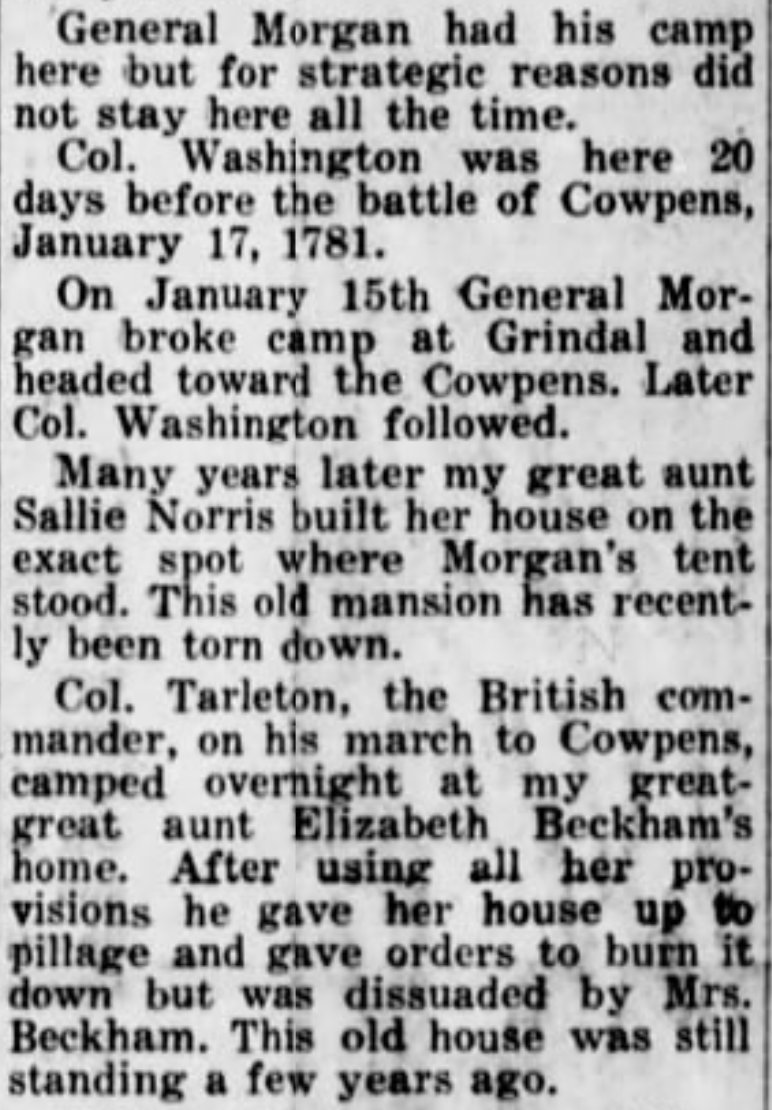
General Morgan had his camp here but for strategic reasons did not stay here all the time. Col. Washington was here 20 days before the battle of Cowpens, January 17, 1781.
On January 15th General Morgan broke camp at Grindal and headed toward the Cowpens. Later Col. Washington followed.
Many years later my great aunt Sallie Norris built her house on the exact spot where Morgan’s tent stood. This old mansion has recently been torn down.
Col. Tarleton, the British commander, on his march to Cowpens, camped overnight at my great-great aunt Elizabeth Beckham’s home. After using all her provisions he gave her house up to pillage and gave orders to burn it down but was dissuaded by Mrs. Beckham. This old house was still standing a few years ago.
WILLIAM HENDERSON

William Henderson, son of Samuel and Ursula Williams Henderson, inherited a large tract of land on the south side of Pacolet River near the Shoals. This land was a grant to Samuel Henderson from King George for services rendered the Crown.
William Henderson, his three sisters and their husbands: Joab Mitchell, Jack Beckham, and Adam Potter, settled on this land about 1774. They were all staunch Whigs.
William joined Sumter’s army and took an active part in the battle of Eutaw Springs where he was severely wounded. After this battle he was made General. William was a first cousin of Col. James Williams of Kings Mountain fame.
Allaire in his diary speaks of being at Col. Henderson on the Pacolet and that Henderson was a prisoner in Charleston, also that he had a fine field of corn growing.
ALEXANDER CHESNEY

An Englishman named Chesney owned a large grant of land on the east side of Pacolet extending both above and below the ford. Chesney being more grateful for his gifts than some of his neighbors, joined the Loyalist. soon he was routed by the Whigs and forced to flee to Charleston where he escaped to England.
ZACHARIAH BULLOCK

Maj. Bullock immigrated from Virginia about 1776 and settled about four or five miles east of Grindal Shoals. He was a member of the Colonial Assembly which shows he was a prominent man.
He was a strong Whig but probably too old to be in active service. He was a brother of Mrs. John Nuckolls of Whig Hill.
ADAM GOUDELOCK
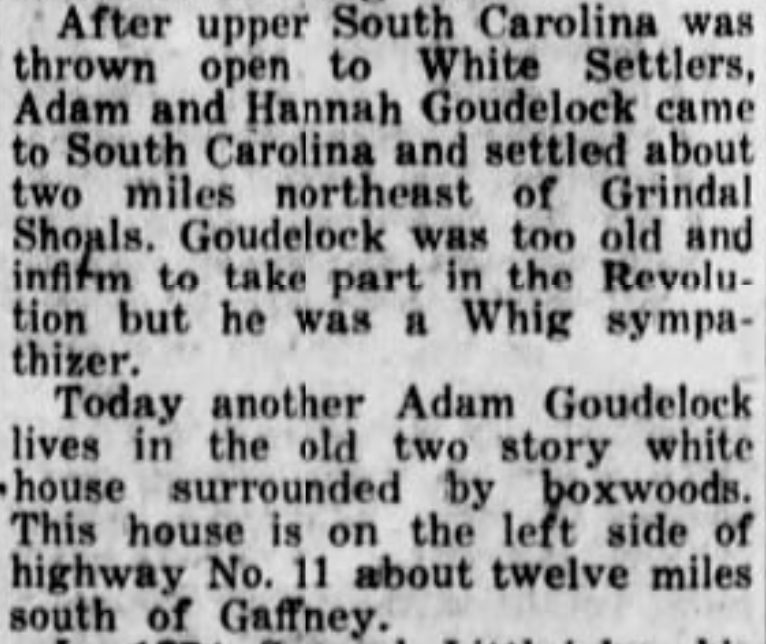
After upper South Carolina was thrown open to White Settlers, Adam and Hannah Goudelock came to South Carolina and settled about two miles northeast of Grindal Shoals. Goudelock was too old and infirm to take part in the Revolution but he was a Whig sympathizer.
Today another Adam Goudelock lives in the old two-story white house surrounded by boxwoods. This house is on the left side of Highway number 11 about twelve miles south of Gaffney.
THE LITTLEJOHNS

In 1774 Samuel Littlejohn, his wife, Sarah Cofer Littlejohn and their first three children: Thomas, Charles and Polly came to South Carolina and settled between Pacolet Riiver and Thickety Creek about six miles north of Grindal Shoals.
Charles Littlejohn was in the Revolution 1779-1781-1782. The old Littlejohn cemetery enclosed by a rock wall is on the old Asbury road. Many of Gaffney’s leading citizens are descendants of this pioneer family.
JOHN CHILSOM

Above the Shoals near the Henderson plantation John Chisolm obtained a tract of land with a large spring on it now known as Chisolm’s Spring. Chisolm settled here some time before the beginning of the nineteenth century. He had five race horses and built a race tract directly in front of his house which was just above the spring.

ABRAM NOTT

Abram Nott, a New England lawyer, graduate of Yale, located at Grindal and boarded with Chisolm. He opened a law office in Chisolm’s house. Several prominent you men came here to study law, among them was David Johnson, later Governor of South Carolina.

August 1794 Abram Nott married Angelica Mitchell. She was the niece of William and John Henderson. After their marriage they lived at the Adam Potter’s place, foster parents of Angelica. This place is called the Nott Place to this day.
Several generations of doctors followed this marriage.
The first Dr. Nott lived once in the big old frame house on the corner of Petty and O’Neal streets in Gaffney, recently torn down, known then as Limestone Springs. Mrs. Angelica Nott survived her husband about nineteen years. She was born December 2, 1771, died June 27th, 1849, and is buried in old Fairforest graveyard.
THE HENDERSONS
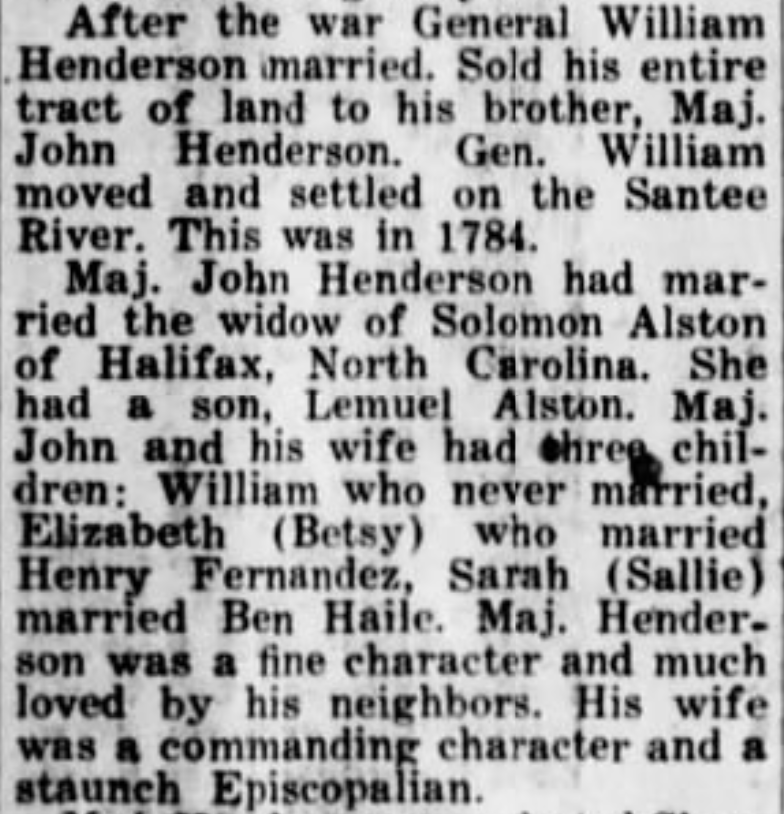
After the war General William Henderson married. Sold his entire tract of land to his brother, Maj. John Henderson. Gen. William moved and settled on the Santee River. This was in 1784.
Maj. John Henderson had married the widow of Solomon Alston of Halifax, North Carolina. She had a son, Lemuel Alston. Maj. John and his wife had three children: William who never married, Elizabeth (Betsy) who married Henry Fernandez, Sarah (Sallie) married Ben Haile. Maj. Henderson was a fine character and much loved by his neighbors. His wife was a commanding character and a staunch Episcopalian.

Maj. Henderson was elected Sheriff of Union district. He employed Henry Fernandez as his deputy. Fernandez’s mother was English, his father was a Spaniard. He came to South Carolina from Maryland. He was well informed and considered a man of keen interest. Shortly after becoming deputy he married Maj. Henderson’s daughter Betsy. Sometime later Maj. Henderson retired to his plantation at Grindal where he lived until his death. He and his wife are buried near the old homestead.
HENRY FERNANDEZ
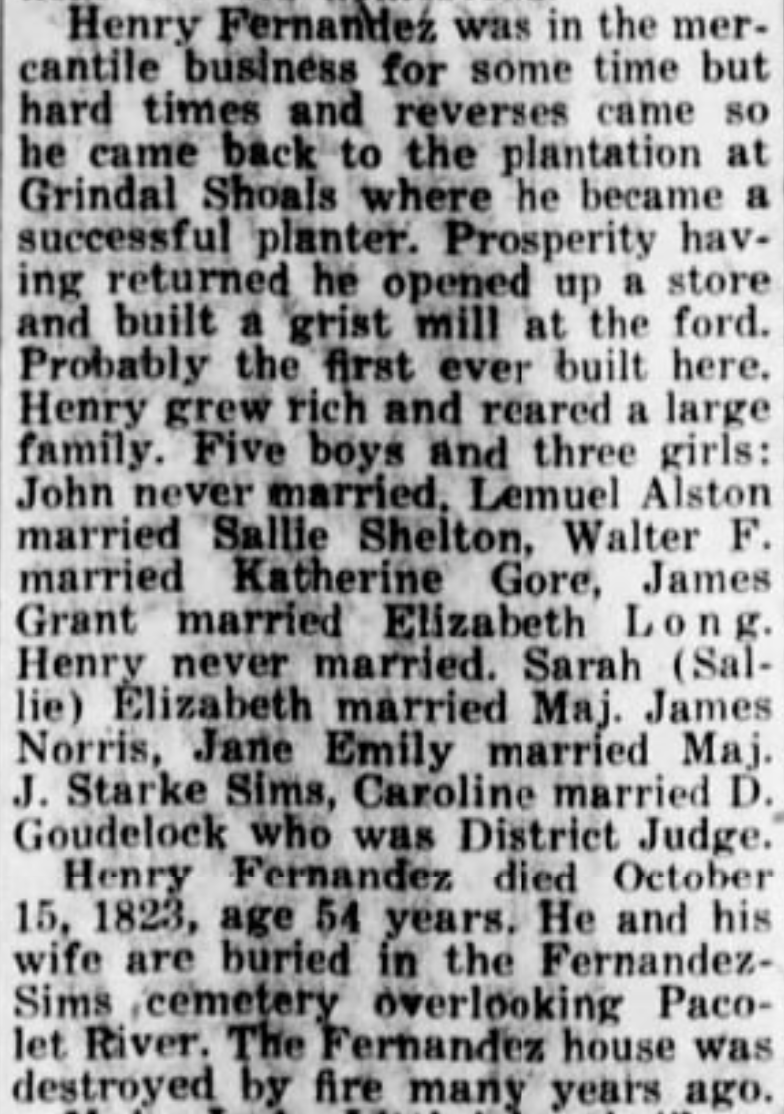
Henry Fernandez was in the mercantile business for some time but hard times and reverses came so he came back to the plantation at Grindal Shoals where he became a successful planter. Prosperity having returned he opened up a store and built a grist mill at the ford. Probably the first ever built here. Henry grew rich and reared a large family. Five boys and three girls: John never married, Lemuel Alston married Sallie Shelton, Walter F. married Katherine Gore, James Grant married Elizabeth Long, Henry never married, Sarah (Sallie) Elizabeth married Maj. James Norris, Jane Emily married Maj. J. Starke Sims, Caroline married D. Goudelock who was District Judge.
Henry Fernandez died October 15, 1823, age 54 years. He and his wife are buried in the Fernandez-Sims cemetery overlooking the Pacolet River. The Fernandez house was destroyed by fire many years ago.

Maj. Jack Littlejohn built a grist mill on east side of the ford opposite the Fernandez mill. After Henry Fernandez death his son, Walter, operated the mill until it washed away. Littlejohn tied his mill to large trees with ropes and saved it.
Later LeRoy McArthur built for Littlejohn a large mill for grinding wheat and corn, also a saw mill.
JOSEPH STARKE SIMS

In 1850 Maj. J.S. Sims built a factory on the south side of the Shoals. It was a wooden structure with machinery for carding wool into rolls and spinning cotton into yarn. This was said to be the first mill ever built on Pacolet River. It was washed away in 1885 and was never rebuilt.
I do not know what became of the Littlejohn grain mill but I believe it was there after the Sims mill went down.

In 1828 Maj. J.S. Sims who married Jane Fernandez built a two story white house with large chimneys at each end directly across from the old Chisolm race track. The house set back about a quarter of a mile from the road and was surrounded by stately oaks and cedars. The long driveway had a row of immense cedars on each side. It was considered a very fine house at this time. Many notable people visited here during the war between the States.

Maj. Sims and his wife reared a large family: five boys and three girls. Joe S. married Lyda Wallace, William M.D. married Maria Louise Darnell, Henry and Edd never married, Charles M.D. married Marietta Mitchell, Sarah Adeline never married, Carrie married Edward Elmore, Mary married Robert W. Hamilton. Joe, Charles and Mary were the last of the Henderson descendants to live at Grindal.
Joe lived at the Nott place until 1890 or 1891, Charles (my father) lived on the Chisolm pace until he came to Cowpens to practice medicine.
Mrs. Mary Hamilton the last owner of the land lived at the old Sims home until the death of her husband shortly after World War I.
Today, Grindal Shoals, stripped of its grandeur, stand barren, deserted and almost forgotten.
written by Mrs. Tula Sims Campbell
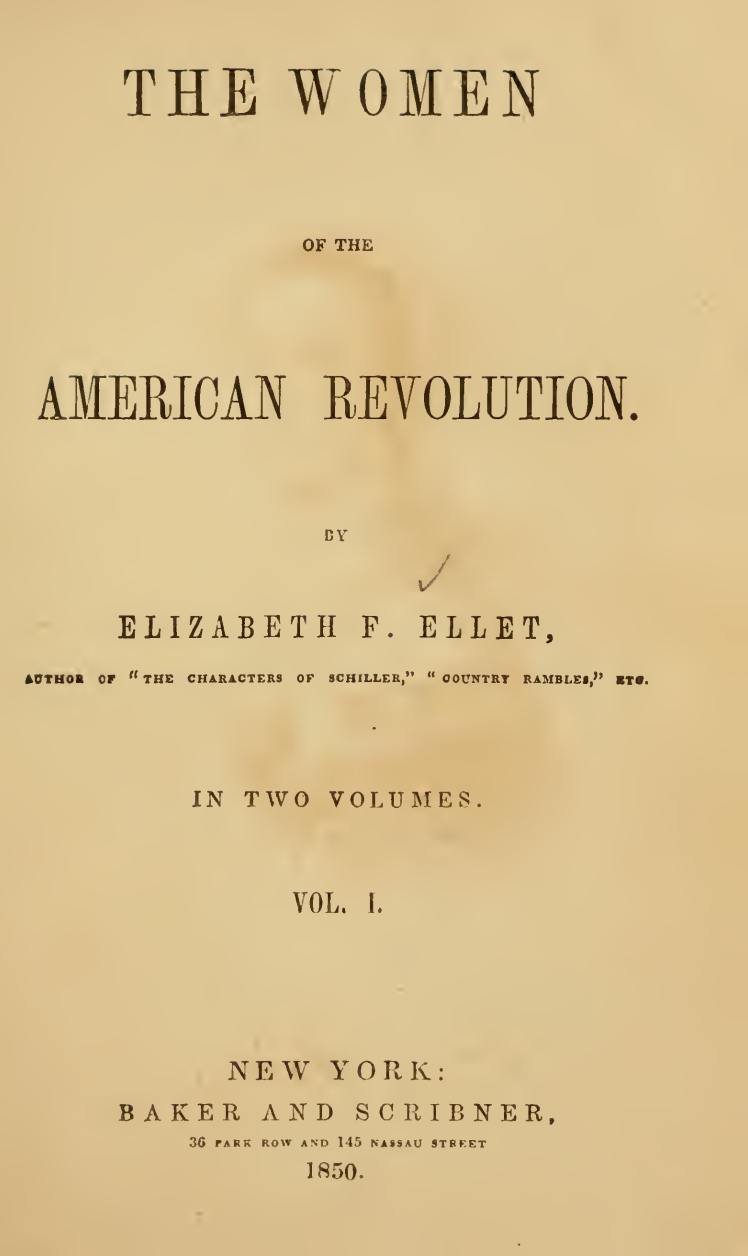
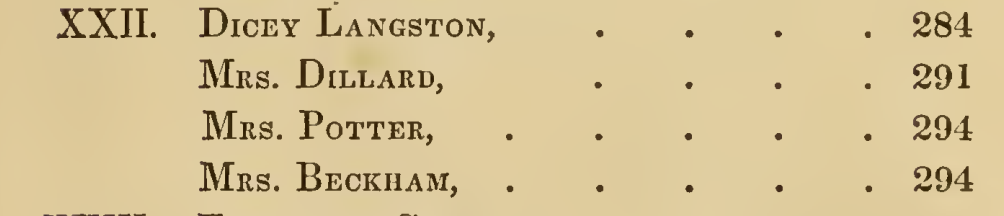
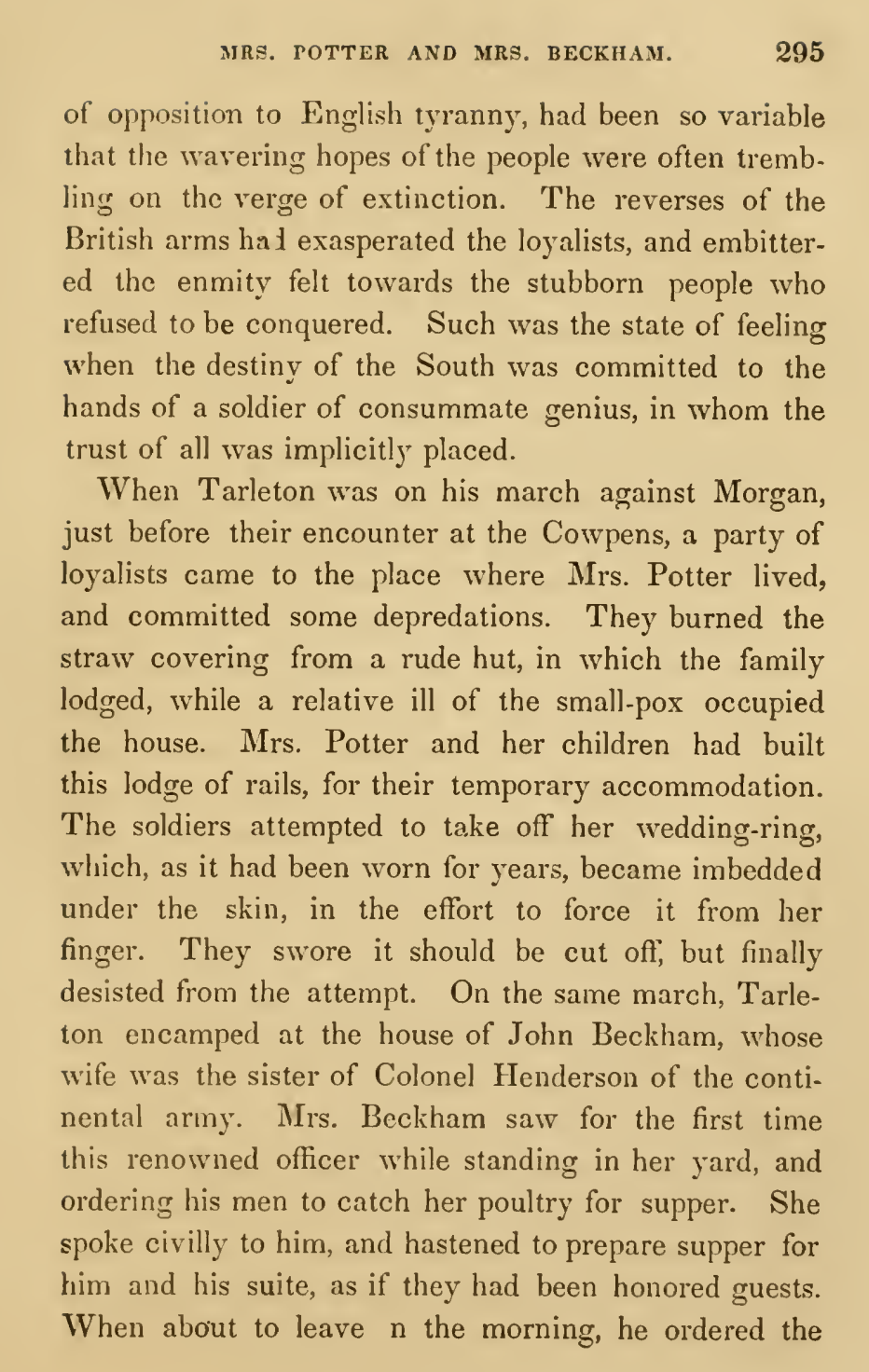
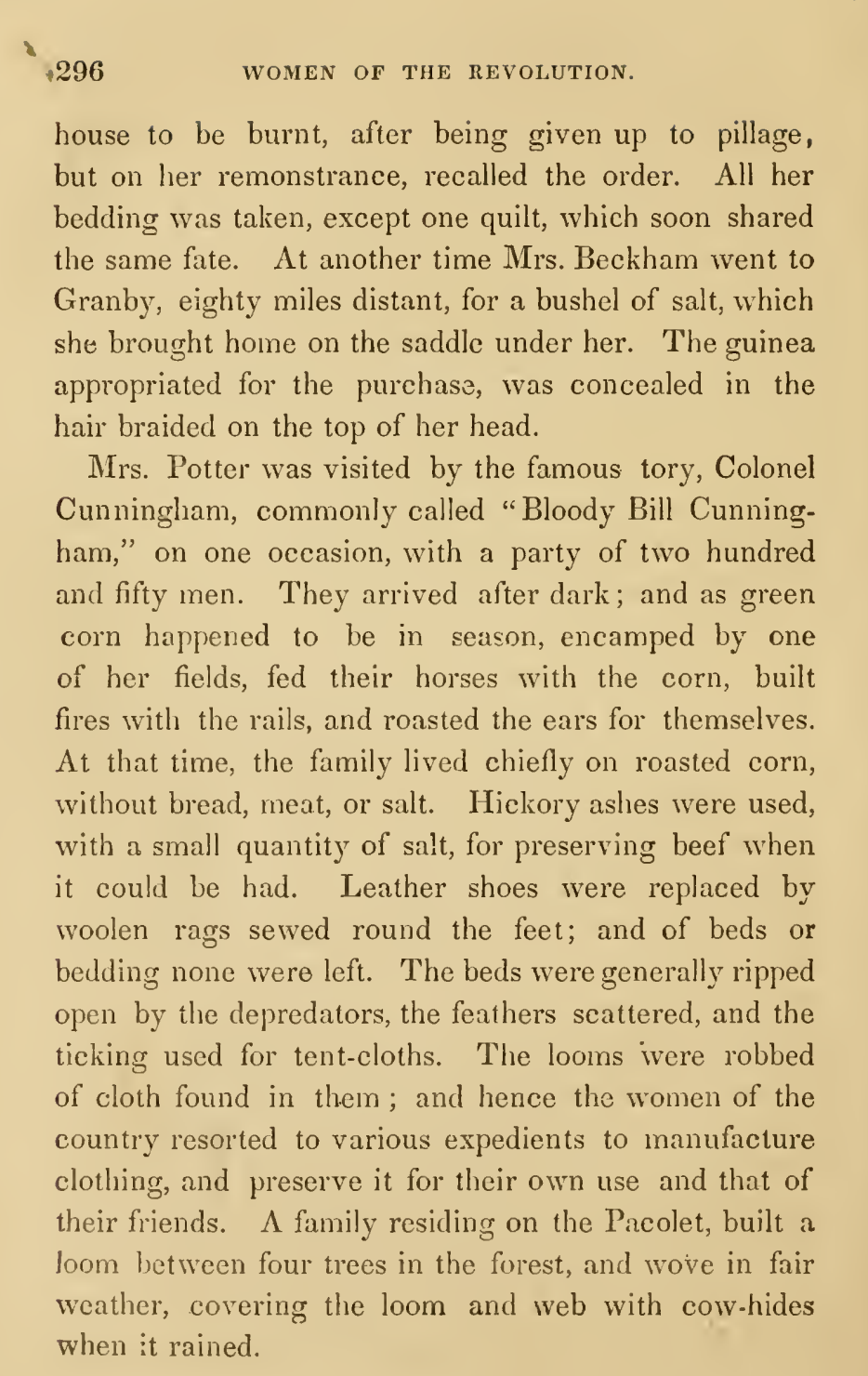
Three women of Grindal Shoals — Mrs. Angelica Nott, Mrs. Adam Potter and Mrs. John Beckham — were mentioned in a book published in 1850 about the American Revolution:

THE CHURCH AT GRINDAL SHOALS
There is little information to be found of the Grindal Shoals Presbyterian Church. There are few people who even know it existed. I had to dig deeply.
But first, I turned to the best, most expert researcher of Union County and South Carolina history:
Mike Becknell wrote to me: “The only church I can think of around there is at the junction of the Jerusalem Road with Hwy. 18. The Grindal Shoals Presbyterian Church stood in the corner of the old road (you can still see part of this just before Jerusalem Rd.) and Hwy 18. There are no remnants of the church left.“
The Presbyterian Church was built at Grindal Shoals in 1858. The church was of the Presbytery of Bethel.

THE REVEREND ALBERT ALLISON JAMES
The Reverend Albert Allison James was born on August 16, 1824 in York County, South Carolina. After many years of early education and college he entered the Theological Seminary in Columbia in 1848.
The Rev. A.A. James graduated in 1851 and began his life’s work of ministering to his congregations.
The Rev. A.A. James became the pastor of the newly built Presbyterian Church at Grindal Shoals in 1858. He stayed with his people of the shoals — preaching to them and saving their souls — until the church disbanded.
He served in the 18th Regiment South Carolina Volunteers as a chaplain during the Civil War, and returned to his congregations after the war ended.
He died in Pacolet, South Carolina on June 3, 1910.
Below left – Chaplain in the Confederate Army;
Below right — aged man of God.


The August 18, 1905 edition of The Gaffney Ledger had a prominent article about the Rev. A.A. James. Mention of the Grindall church was made:

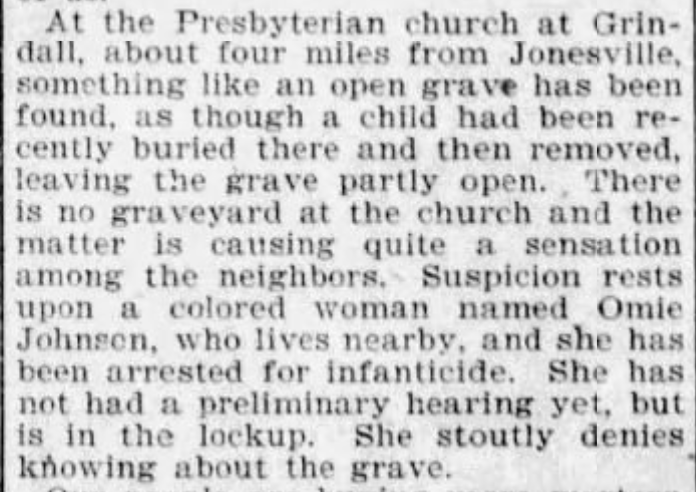
An open grave scandal in 1901 at the Grindall Presbyterian Church resulted in the arrest of a local woman accused of infanticide. The matter may have been dropped as I find nothing after this initial article:
May 1883. The church partially collapsed during a communion service as the Rev. James preached his sermon. Mrs. R. D. Hammett recovered from her severe injuries and lived a few more years.

It must have been a very sad day in 1906 for the people of Grindal Shoals when their church was sold for one hundred dollars and fifty cents.

The Presbyterian church in Jonesville with whom they united was on the street where I lived as a child in the 1960s and 1970s.
There were only a handful of elderly members who attended the Presbyterian Church in Jonesville. Sadly, the church suffered the same fate as the Grindal Shoals church. The members passed on to their heavenly rewards one-by-one, and the church was sold.
A RETURN TO THE BEGINNING
Grindal Shoals, like her church, has slowly faded into the past. The passing years have returned the shoals to its primitive state.
Newly arriving settlers had discovered her pristine beauty and abundant wildlife and made the shoals their home. Looking at the land surrounding the shoals today, it is impossible to see that there was once a thriving community.
So many treasures came out of the shoals. It was not only a strategic crossing that led to a victory in the Revolutionary War. We were gifted the art and literature of Addie Sims, the service of a sheriff, lawyers, politicians, and a governor, the owners of mills and industry who supplied their neighbors with wool, grain, and lumber.
Grindal Shoals was a gem on the Pacolet River. Part Two will further examine the lives of the men, women, and children who lived there from the mid 1700s to the mid 1900s. Stay tuned……..
 THE FOWLER FAMILIES OF UNION COUNTY, SC
Again, a fascinating article. I’m particularly interested in the old Goudelock family. Some of their descendants are buried at Philippi Bapt. with my ancestors. Do you know if the Adam Goudelock house on Hwy 11 still stands?
LikeLike