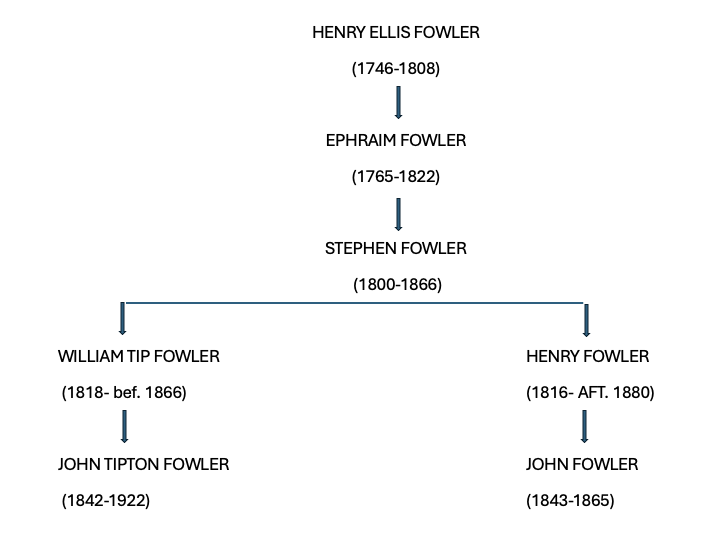
John Fowler was born in 1846 to Henry Fowler, son of Stephen Fowler, son of Ephraim Fowler, son of Henry Ellis Fowler.
I believe the John Fowler who enlisted in Company F of the 18th Regiment South Carolina Infantry was the son of Henry Fowler.
If you research these Fowlers of Union County, South Carolina, you will see that there are many family trees showing John Tipton Fowler as the son of Henry Fowler.
I believe those family trees to be wrong. My own research indicates that John Tipton Fowler was born in 1842 to William Tip Fowler, son of Stephen Fowler, son of Ephraim Fowler, son of Henry Ellis Fowler.
John Tipton Fowler (son of William Tip Fowler) and John Fowler (son of Henry Fowler) were first cousins.
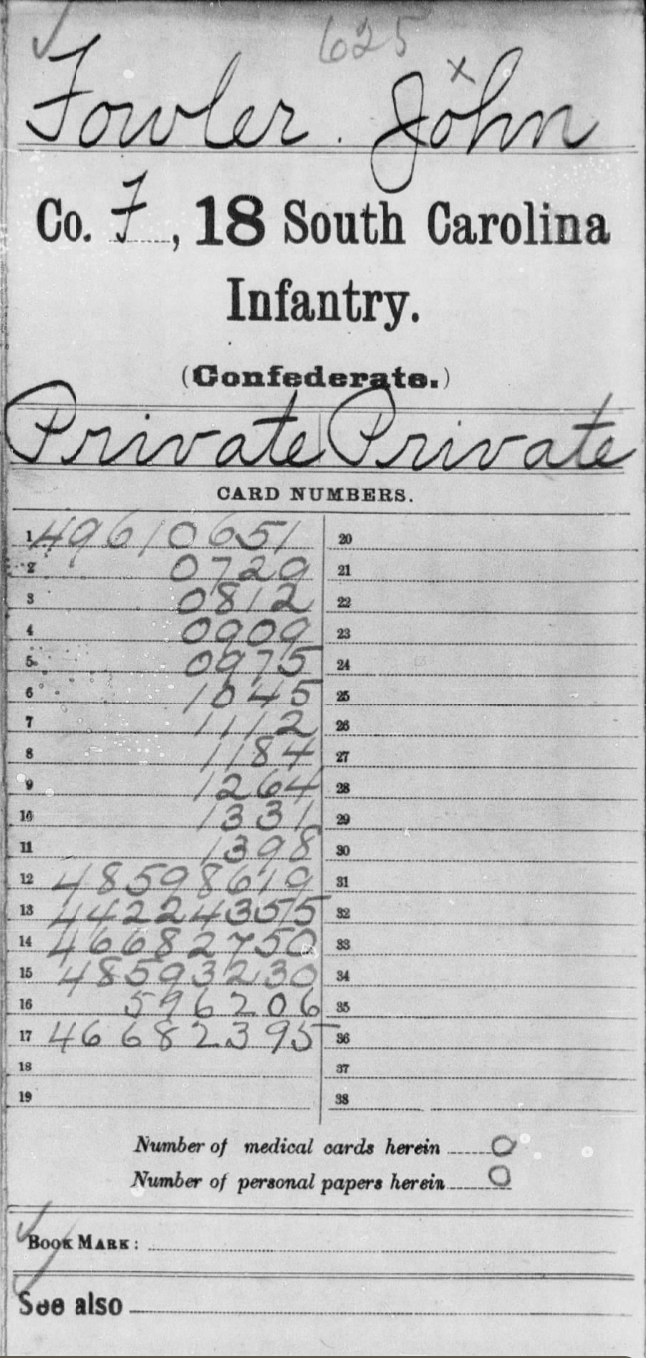
John Fowler enlisted in Captain J. Felix Walker’s Company, 18th Regiment of the South Carolina Infantry on December 18, 1861. He enlisted at old Davis Field in Union District.
Captain James Felix Walker (b. 1824) would die on the tenth of September 1862 from wounds he received in the Second Battle of Manassas in Virginia. He was a son of James Fowler Walker (1795–1857).
Newton F. Fowler followed in his brother John’s footsteps three years later. He enlisted in Company F, 18th Regiment South Carolina Infantry on January 28, 1864 in Charleston, South Carolina.
The brothers Fowler — Newton and John — fought side-by-side for the next few months.
The Yankee army captured Newton Fowler on July 30, 1864 in Petersburg, Virginia. He was sent to Point Lookout, Maryland on August 5, then transferred to the Yankee Prisoner of War camp in Elmira, New York on August 8, 1864. Newton F. Fowler died of Typhoid Fever on August 31, 1864 in the prison at Elmira. He was buried near the prison in a trench grave.
Did John Fowler know the fate of his brother? If he did, he had little time to reflect on or mourn the death of young Newton.
John Fowler had his own trials and tribulations looming upon the horizon.
Other than a brief illness a month after he enlisted in the army, military records indicate that he was present and active in his regiment until the autumn of 1864.
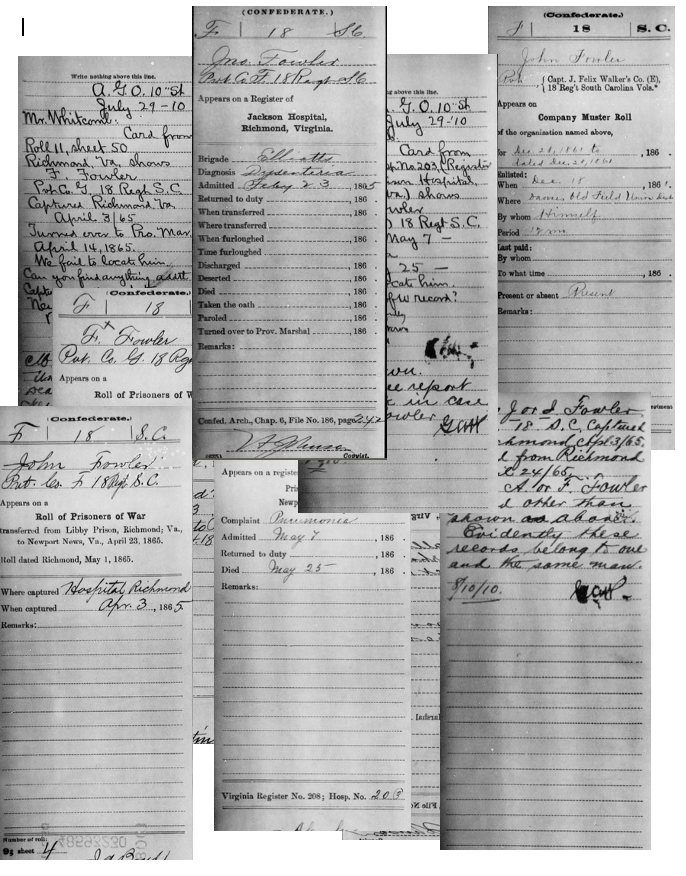
Between October 18, 1864 and April 2, 1865, John Fowler was admitted into the Jackson Hospital at Richmond no less than four times. His illnesses were chronic diarrhea, remittent fever, dysentery, and pneumonia. He certainly had the symptoms of malaria or typhoid fever, sometimes referred to as camp fever.
His last days on earth must have been pure misery. Never mind that he had spent the previous three and a half years living in squalid conditions, half-starving, hot in summer months and freezing in winter, fighting on bloody battlefields watching his brothers-in arms die all around him. Now he had to endure months of fevers and constant diarrhea.
He must have longed for death at times.
If John Fowler thought that things could not get worse, he was wrong. He was captured by the Yankees while he was in the hospital at Richmond. He was turned over to the Provost Marshall and then moved to nearby Libby Prison.
A LINK to infomation of Libby Prison: https://encyclopediavirginia.org/entries/libby-prison/
As the years-long war came to an end, a POW camp to hold and process Confederate soldiers was quickly built next to Camp Butler on Newport News Point. The camp sat on twenty-five acres surrounded by a twelve-foot high fence.
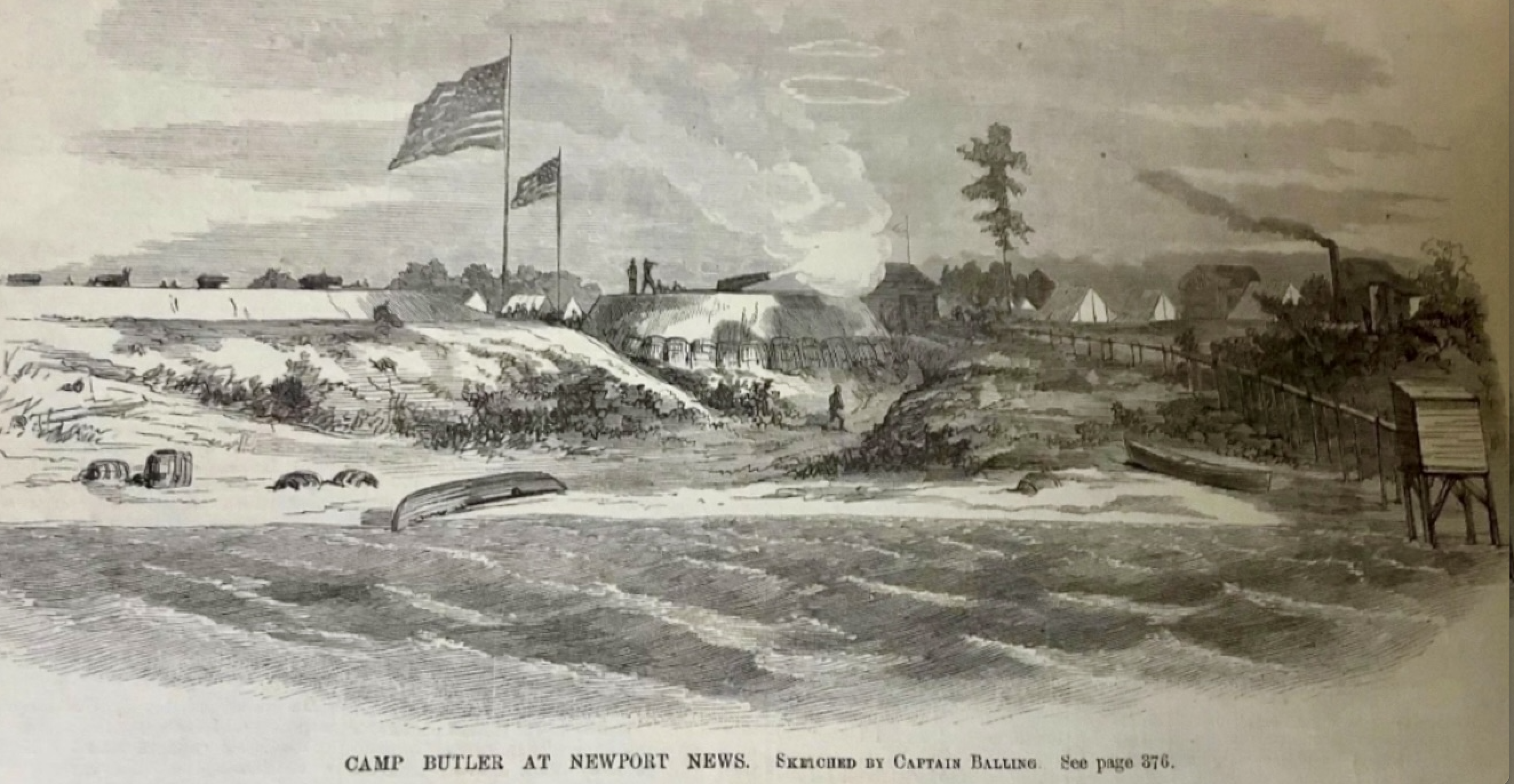
Less then ten days later, he was shipped from Libby Prison in Richmond to the POW camp at Camp Butler in Newport News.
Not long after his arrival at the POW camp, he was admitted one more time to a hospital — this time the newly built prison hospital at the POW camp.
It was here that John Fowler died. Struggling to breath from the fluid that filled his lungs, he welcomed death.
A TIMELINE OF THE LAST MONTHS OF JOHN FOWLER
- Oct 18 1864: Admitted Jackson Hospital chronic diarrhea
- Nov 14 1864: Furloughed for 60 days
- Dec 8 1864: Admitted Jackson Hospital for febris ret. (remittent fever)
- Dec 15 1864: Included on Jackson Hospital Muster Roll
- Dec 21 1864: Returned to duty
- Feb 23 1865: Admitted Jackson Hospital for Dysentery
- April 2 1864: Admitted Jackson Hospital
- April 3, 1865: Captured in hospital by Union Army
- April 14 1865: Turned over to Provost Marshall
- Apr 23 1865: Transferred – Libby Prison in Richmond to Newport News, VA
- May 7 1865: Admitted to prison hospital in Newport News
- May 25 1865: Died from pneumonia

Greenlawn Cemetery in Newport News was established in 1888. The remains of 20.000 souls surround the 163 Confederate soldiers who were re-interred in a mass grave in the center of the cemetery in 1900.
These brave men — prisoners of war — died at the POW camp near Fort Butler between April 27 and July 5, 1865. A twenty-five foot obelisk stands guard over their grave and a granite ledger lists the name of each man, his rank, state and regiment.
John Fowler is memorialized on the stone. His bones lie in the mass grave along with the soldiers with whom he lived, fought beside, and died alongside.

Henry Fowler and his wife Lucinda sent two sons off to war. Neither son returned home. Newton Fowler survived only six months before his young life ended. John Fowler managed to stay alive and well for three and a half years before his body, ravaged by poor living conditions and battle, gave up the fight for life. Ironically, his death occurred after the war had ended.
Like many of the Confederate dead, both men would be hastily buried in mass graves in faraway lands. Their family would eventually learn of their deaths but have no real closure.
The sound of their voices would fade from memory, and if no tintype had been made, the only image of the dead would be in the minds of the living.
It was a steep price to pay for war. It always has been. It always will be.
 THE FOWLER FAMILIES OF UNION COUNTY, SC
So much concentration and research to unravel all these Fowler family members! John Fowler would have been my 2nd great grandmother’s brother (Sarah Ann Fowler Goforth’s brother). I’m thankful that John was recognized and memorialized on the obelisk. Thanks again for your efforts! Linda V.
LikeLike